



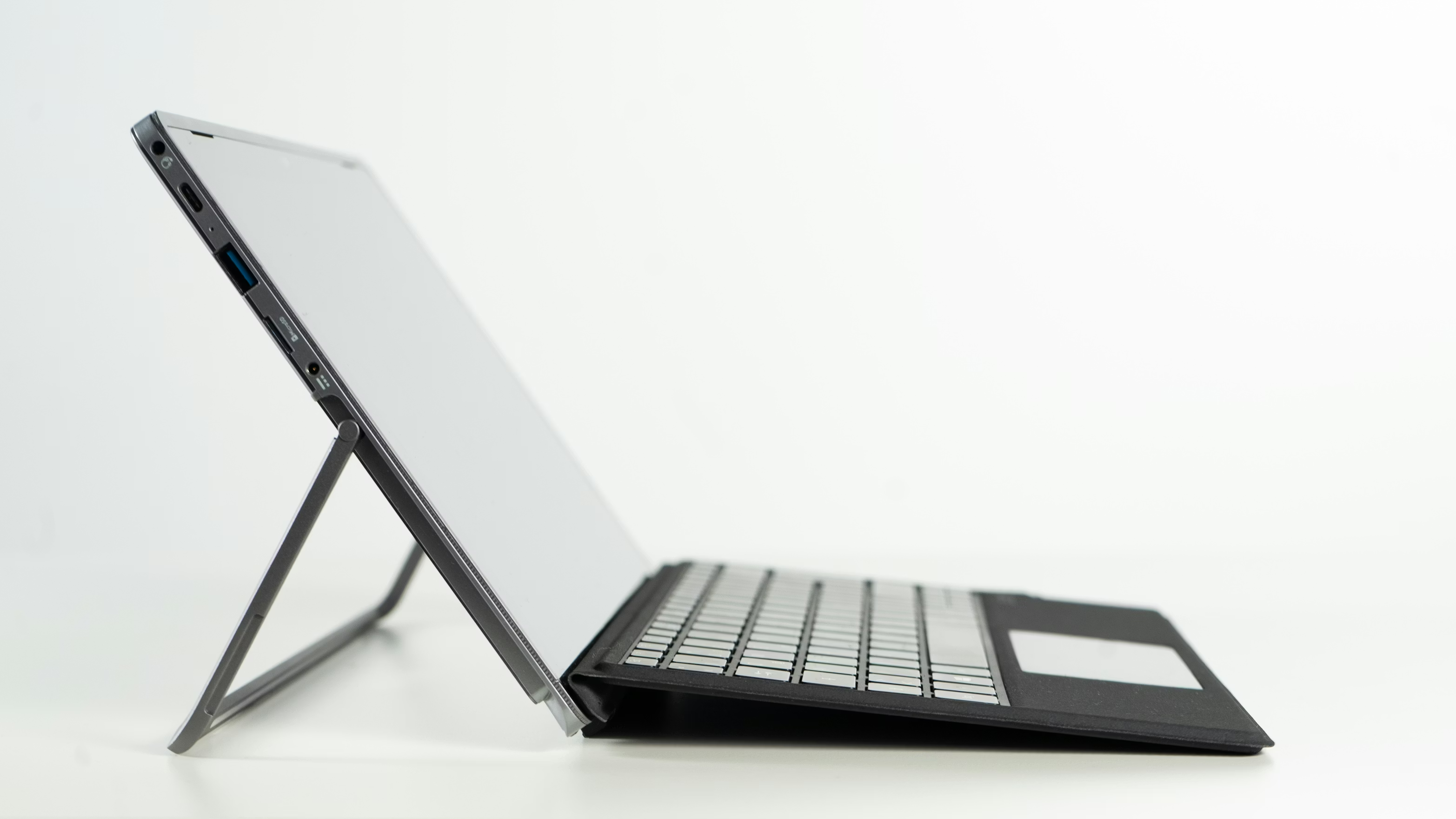
The tech world has seen its share of ambitious multi-OS experiments, but few have captured attention quite like devices that promise to run multiple operating systems seamlessly. Google's recent push into unified platforms demonstrates just how seriously major tech companies are taking this concept, with Google developing Aluminium OS, a unified Android-based PC platform that merges ChromeOS and Android to compete with Windows and macOS.
Meanwhile, Microsoft has secured a patent for multi-OS booting technology that could enable devices to switch between operating systems or boot only necessary OS components based on user needs. The concept has even made its way into consumer devices, with Lenovo's ThinkBook Plus Gen 5 Hybrid combining a Windows laptop and Android tablet into a single form factor.
Unlike earlier multi-OS efforts that were limited in scope, today's initiatives are backed by large vendors and aimed at improving everyday productivity for mainstream users.
Why multi-OS devices are finally becoming reality
The convergence of several technological advances has created the perfect storm for multi-OS devices to transition from concept to reality. Google has indicated Android for PC is in development, with testing expected in 2026 and broader rollout later. Rather than adding isolated features, this approach focuses on tighter integration between mobile and desktop workflows.
The technical foundation has been maturing quietly in the background. Waydroid demonstrates this perfectly, allowing Android to run inside a Linux operating system using a Linux container. Since Android shares Linux's core architecture, containerization becomes surprisingly efficient, avoiding the resource overhead that plagued earlier virtualization approaches. This containerized method delivers near-native performance while maintaining system isolation - a critical breakthrough for practical implementation.
Microsoft's patent takes this efficiency concept even further. Rather than running complete operating systems simultaneously, their method allows devices to select the OS necessary to perform certain tasks. This selective activation approach could dramatically reduce resource consumption while providing specialized functionality exactly when needed.
The hardware landscape has also reached a tipping point. Modern ARM and x86 processors now possess sufficient computational headroom to handle multiple OS environments without the performance penalties that made earlier attempts impractical. Combined with advanced power management and sophisticated virtualization capabilities, the technical barriers that once made multi-OS devices unrealistic have largely dissolved.
Real-world implementation challenges and solutions
While the technology shows promise, current implementations reveal the significant engineering challenges that remain. Lenovo's approach with the ThinkBook Plus Gen 5 Hybrid illustrates both the potential and the pitfalls of today's multi-OS hardware strategies. The dual-boot ThinkBook Plus Gen 5 Hybrid doesn't work as well in practice, highlighting why manufacturers are struggling to balance functionality with practicality.
Lenovo's solution essentially embeds two complete computers into one device: the Hybrid Tab is powered by a Snapdragon 8+ Gen 1 processor with 12GB RAM, while the Hybrid Station uses an Intel Core Ultra 7 155H processor with 32GB RAM. This dual-processor approach guarantees compatibility and performance but creates obvious compromises. The result is a larger, heavier design with shorter battery life than traditional laptops, demonstrating why hardware-based solutions may not be the long-term answer.
Software-based approaches face different but equally challenging obstacles. While Waydroid achieves impressive results, some apps like Reddit and Amazon Prime Video have compatibility issues. These aren't random glitches - they reflect deeper architectural tensions between different OS security models, hardware abstraction layers, and application frameworks. When problems occur, users often find themselves restarting the Android container or switching desktop environments just to restore normal functionality.
The challenge extends beyond technical implementation to user experience design. Creating intuitive interfaces that make OS switching feel natural rather than jarring requires rethinking fundamental assumptions about how people interact with their devices. Current solutions often feel like engineering demos rather than polished consumer products.
Market positioning and competitive landscape
The business strategy behind multi-OS devices reveals a fascinating battle for the future of premium computing. Google's job listing for a "Senior Product Manager, Android, Laptop and Tablets" directly references work on a "new Aluminium, Android-based operating system", signaling that this isn't just a technical exercise, but a calculated move to capture market share from established players.
The pricing reality, however, exposes the current value proposition challenges. Lenovo's ThinkBook Plus Gen 5 Hybrid is priced at $2750 USD, placing it firmly in premium territory despite its first-generation limitations. This premium pricing strategy makes sense only if multi-OS capabilities deliver genuine productivity advantages that justify the cost premium over separate devices.
Google's broader ambitions become clear through their tier structure. References to "AL Mass Premium" and "AL Premium" tiers indicate Google wants Aluminium OS devices to compete directly with high-end Windows and macOS machines. This represents a fundamental shift from Google's historical focus on budget-friendly Chromebooks to a direct assault on Microsoft and Apple's most profitable market segments.
The competitive implications extend beyond individual devices to entire ecosystem strategies. Success in multi-OS devices requires seamless integration across cloud services, application compatibility, and cross-platform data synchronization. Companies aren't just competing on hardware specifications or OS features - they're competing on their ability to make the complexity invisible while delivering tangible user benefits.
Where multi-OS technology heads next
The evolution toward AI-driven OS management represents the most promising path for solving current multi-OS challenges. Google's Aluminium OS is reportedly "built with AI at the core," suggesting deep integration with Google's Gemini model. This AI-first approach could transform multi-OS devices from manual switching systems to intelligent platforms that predict and adapt to user needs automatically.
Microsoft's vision pushes even further into cloud-native territory. Their patent describes allowing operating systems to be stored in the cloud and streamed as needed, potentially eliminating the storage and performance overhead that plague current implementations. This cloud-streaming approach could deliver faster boot times and lower resource footprints while providing access to specialized OS environments without requiring local installation.
The strategic transition is already underway. Google's job listing tasks recruits with defining a plan to transition "Google from ChromeOS to Aluminium with business continuity in the future", indicating this technology will ultimately replace current single-OS platforms rather than simply complement them. This suggests we're witnessing the early stages of a fundamental computing platform shift.
AI integration could solve many current usability challenges through predictive OS selection. Instead of manual switching, future systems might automatically activate productivity environments for work tasks, gaming modes for entertainment, or streamlined interfaces for quick communications. The key breakthrough would be making these transitions so seamless that users stop thinking about which OS they're using and focus entirely on their tasks.
As cloud infrastructure improves and AI becomes more sophisticated at understanding user context, the vision of truly unified multi-OS devices moves from ambitious concept to inevitable reality. The current implementations may feel rough around the edges, but they're laying the groundwork for a computing paradigm where the operating system adapts to the user rather than the other way around.








Comments
Be the first, drop a comment!