



Some market watchers expect a sharp decline in sub-$400 shipments this year, according to Omdia data reported by Android Authority. The cause is a memory supply crunch driven by AI infrastructure demand, and the segment taking the worst of it is precisely the one with the least room to absorb it.
AI data centers increasingly rely on High-Bandwidth Memory, a product category distinct from the LPDDR4X that powers most budget phones. The link is fabrication capacity: as major chipmakers have redirected production toward HBM to serve AI clients paying a substantial premium, output of the older memory standards that populate low-to-mid-range devices has contracted sharply. TrendForce identified this reallocation as an accelerating shift with no reversal mechanism in sight.
Why rising RAM prices are hitting sub-$400 smartphones hardest
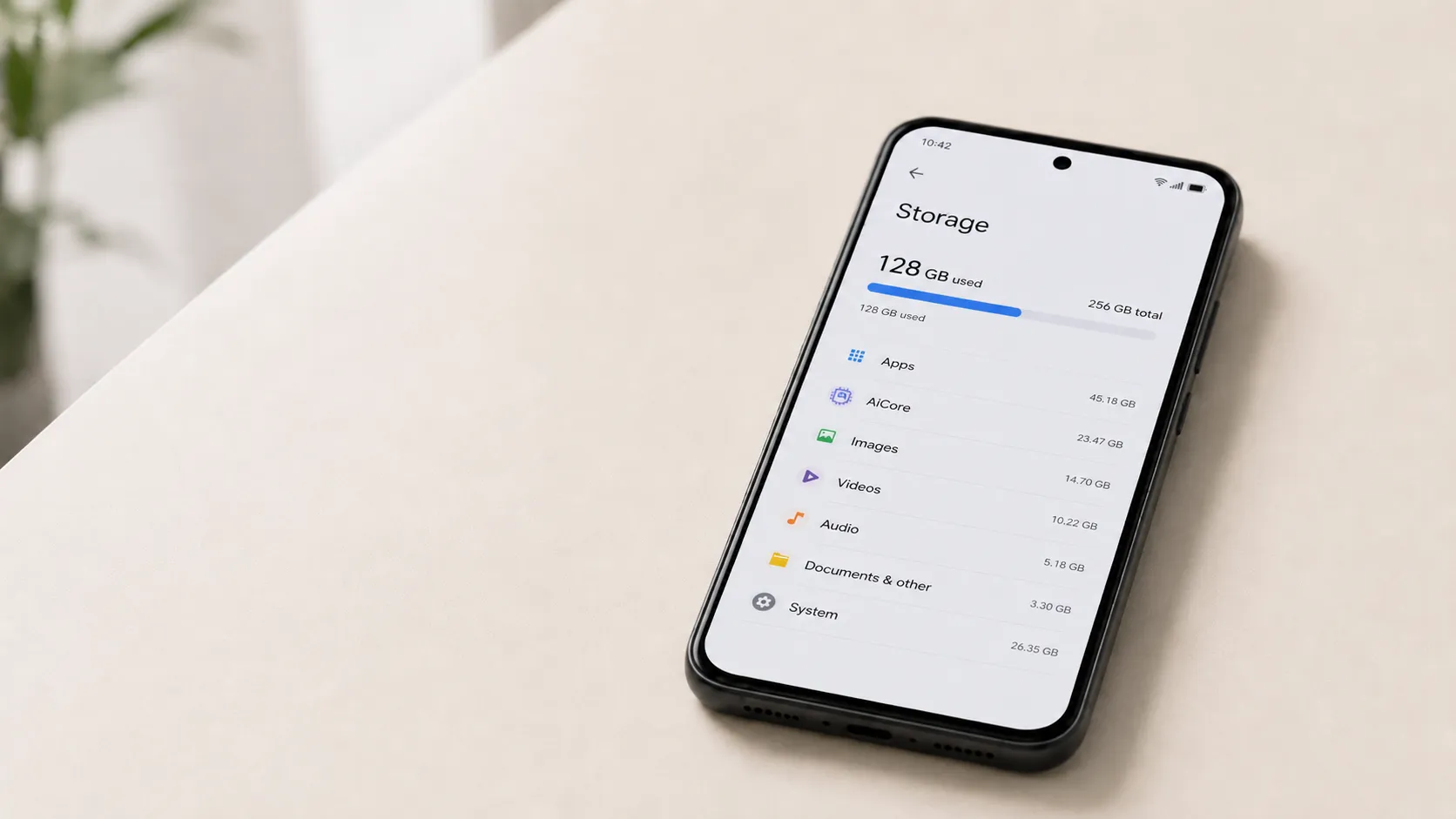
Memory and storage combined, RAM plus onboard flash, accounted for roughly 31-33% of total component costs for sub-$400 phones in Q3 2025. By Q1 2026, that share had climbed to 59-64%, per Omdia data cited by Android Police. For phones under $100, the figure reaches 64%. Close to a doubling in under a year.
Premium devices face the same cost environment but are not suffering the same consequences. Omdia forecasts shipments of phones priced above $400 will grow 5.7% in 2026 while the sub-$400 segment falls 22%, Android Authority reported. A $900 device has a margin to absorb component cost increases that would gut the economics of a $250 one.
Budget manufacturers already run on the thinnest margins in consumer electronics, and Android Police notes the Omdia report describes the impact on that tier as "catastrophic." The same cost spike is producing opposite outcomes depending on where a device sits in the market.
How AI infrastructure reshaped the memory supply chain
Major chipmakers are accelerating the phase-out of LPDDR4X to focus production capacity on advanced-node products built for AI workloads. TrendForce described LPDDR4X's exit from smartphone applications as "an irreversible trend," signaling severe near-term supply disruption. Smartphone brands facing consecutive production halts or sharp output reductions from key suppliers must now overhaul their memory specifications from scratch.
Samsung's numbers confirm the dynamic from the supply side. Its Memory Business set a quarterly sales record in Q1 2026 by serving what it called "high-value-added AI demand" under constrained supply, with industry-wide memory price increases compounding the effect, per Samsung's Q1 2026 earnings report.
The Device Solutions division, which produces HBM and related memory products, posted an 86% quarter-on-quarter revenue jump. That record profit came from the same constrained supply environment that is raising costs for every smartphone manufacturer trying to source LPDDR4X.
The pressure has reportedly been building since 2025, when rapid AI data center expansion began straining the manufacturing pipeline. Samsung's Q1 earnings guidance anticipated strong AI memory demand continuing through Q2 2026, with the first HBM4E samples scheduled for delivery. What began as background pressure has become an active supply shortage, now showing up in product decisions. TrendForce's conclusion is pointed: this officially ends the smartphone industry's decade-long model of "high specs at low prices."
Early casualties: what brands are already doing
The clearest signal is a cancellation. Nothing's sub-brand CMF shelved the CMF Phone 3 Pro before it launched. Co-founder Akis Evangelidis wrote publicly that "we were working on a successor, but with memory prices where they are right now, we can't build a phone that feels like a genuine step forward at a price that makes sense for CMF." A founder calling off a product mid-development because the unit economics no longer work is a different signal than a price adjustment.
Other brands have chosen to hold specs and pass the cost on. Honor maintained 12GB of RAM in the 600 Pro but raised the asking price by £200 to make the numbers viable. The constraint is reaching higher up the stack too: the Oppo Find X9 Ultra ships with 12GB of RAM while its older, cheaper predecessor, the Find X9 Pro, had 16GB.
A pricier successor launching with less RAM than the model it replaced is a real indicator of supply pressure. At the budget end, where there is no margin buffer, the same dynamic is categorically more severe.
TrendForce advises that brands across all tiers must completely overhaul their memory specification configurations and accelerate hardware platform upgrades to cope with sustained supply contraction and persistently high pricing.
What the budget phone market looks like from here
Three outcomes are plausible for sub-$400 buyers in 2026: higher prices for equivalent specs, lower specs at familiar price points, or, as CMF demonstrated, no phone at all. Expert Reviews raises the possibility that budget phones could revert from the 8GB and 12GB RAM configurations that became standard over the past few years to 4GB or 6GB. The Motorola Moto G17, shipping with 4GB of RAM, is cited as an indicator of where the floor may already be.
Omdia suggests manufacturers may pull back from the sub-$400 segment entirely in favor of premium lines where component costs are easier to absorb. Fewer brands competing at the low end means less pressure to hold value, which is how a competitive market starts to hollow out. Omdia has separately warned that rising memory and storage costs are pressuring device shipments.
The Google Pixel 9a had dropped to its lowest UK price yet at the time Expert Reviews published its analysis, with the publication noting it is barely a downgrade from the current Pixel 10a. A discounted prior-year device outperforming newer budget releases on value is a direct consequence of what is described above. SK Group Chairman Chey Tae-won has said the global chip wafer shortage is likely to persist until 2030.
New fabrication capacity will eventually come online, but nothing in the current data supports a meaningful near-term reversal. The budget smartphone market that spent a decade delivering more performance per dollar is now facing a cost structure it was not designed to absorb, and manufacturers are still working out what they can no longer afford to build.












Comments
Be the first, drop a comment!