



![[1+1] Pack Screen Protector for Vivo X Fold6 with Lens Protector](https://m.media-amazon.com/images/I/615tKFiJDuL._AC_UY218_.jpg)


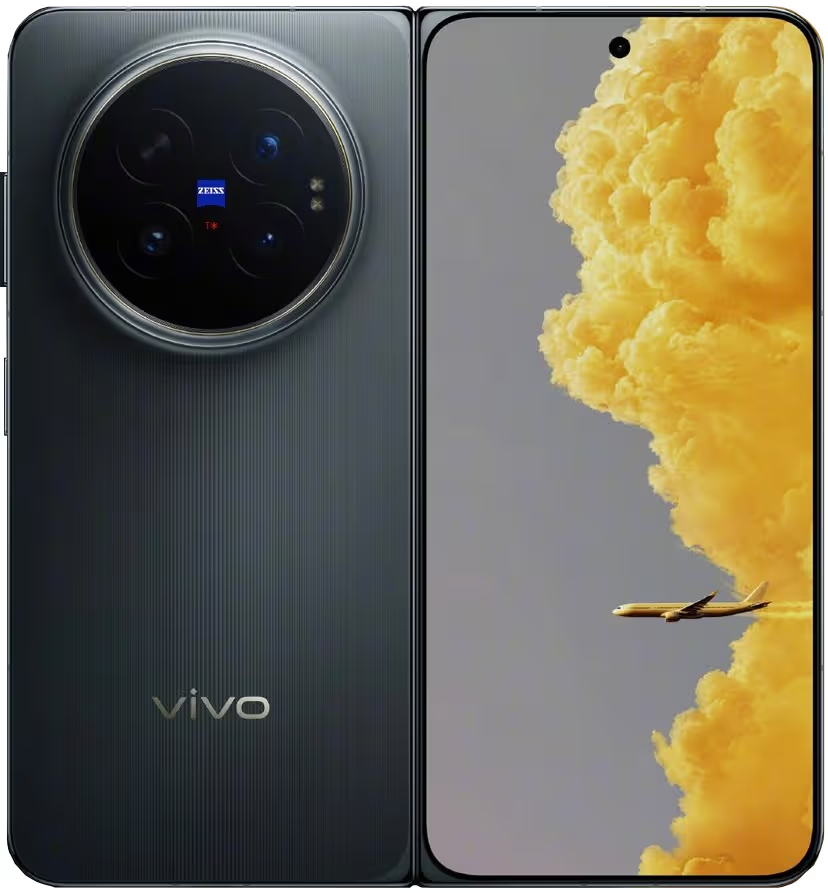
vivo launched the X Fold6 in China on June 26, pairing a 7,000mAh battery with ZEISS G2 telephoto converter support and a thinner book-style foldable design. The launch gives vivo a clearer answer to two long-running foldable complaints: battery life and camera reach.
Confirmed China pricing starts at CNY 7,999 for the 12GB/256GB model, with higher configurations rising to CNY 11,299 for the Black Gold 16GB/1TB version. That keeps the X Fold6 firmly in premium foldable territory, but its official base price is far below the CNY 9,999 figure that circulated before launch.
A bigger battery tackles a foldable pain point
Battery life remains one of the easiest foldable compromises to understand. A book-style foldable has to power two displays while leaving room for a hinge, cameras, cooling, and a thin frame.
The X Fold6's 7,000mAh battery is larger than the 6,660mAh battery in Honor's global Magic V6, though Honor's China-market version reaches 7,150mAh. The Verge's review said the Magic V6 could last about two days between charges, but the X Fold6 will need independent testing before its capacity can be treated as real-world endurance.
vivo also built the X Fold6 around a high-end display package. The 8.02-inch inner display uses Samsung's M14 luminous material, reaches a claimed 5,000 nits outdoors, and can drop to 1 nit for low-light use, according to Android Authority. The phone also uses a Dimensity 9500 Super Edition chipset and supports external-display desktop mode, giving it a stronger productivity pitch than battery capacity alone.
Durability is still a question to treat carefully. The X Fold6 has water-resistance claims attached to its launch, but it should not be framed as matching Honor's IP69 benchmark unless vivo's final spec sheet confirms the same level of dust and water protection. For buyers, the more practical point is that foldables still depend on hinges, soft inner screens, and repair support in ways slab phones do not.
ZEISS teleconverter support gives the camera a real hook
The ZEISS G2 telephoto converter is the X Fold6's most unusual camera feature. The physical accessory enables 200mm-equivalent photos, giving vivo a different foldable-camera pitch: extra optical reach from an attachment instead of relying only on sensor crops or digital zoom.
vivo has been building toward this through the X300 Ultra, its China-market camera flagship with external telephoto converter options. The X Fold6 supports the 200mm ZEISS G2 converter, but Android Authority reported that it does not support the 400mm teleconverter available for the X300 Ultra.
The built-in camera hardware is also stronger than a typical foldable setup: a 200MP main camera with a 1/1.4-inch sensor, a ZEISS APO Super Telephoto lens using Sony's LYT-602 sensor, and vivo's V3+ imaging chip. Those specs make the X Fold6 a camera-first foldable on paper, though reviews still need to show whether the hardware delivers in motion, low light, portraits, and long-range shots.
Two buying details still need confirmation: whether the ZEISS G2 converter is bundled or sold separately, and whether independent testing shows a clear advantage over the built-in telephoto camera. The accessory is the most interesting part of the X Fold6's camera story, but it also adds another item to carry, store, and potentially pay extra for.
China-only launch limits the buying appeal
The X Fold6 has no confirmed global launch, which makes the price less useful for shoppers outside China. Honor's Magic V6 shows how slowly these launches can travel: it debuted at MWC in February 2026, began selling globally in Malaysia and Singapore in June 2026, and was expected to reach the U.K. and Europe later that month.
That availability gap matters more than the spec sheet. A foldable with a 7,000mAh battery, high-end displays, and clip-on telephoto support is easy to admire from a distance, but it is harder to recommend until vivo confirms where it will sell the phone and what support buyers will get outside China.
Independent reviews also need to test the claims that matter most in daily use: battery life, hinge feel, heat management, camera processing, and whether the teleconverter is useful enough to carry. The X Fold6 shows how quickly Chinese foldables are moving on battery size and camera hardware. For now, its biggest limitation is simple: vivo has not said where else it will be sold.






Comments
Be the first, drop a comment!