





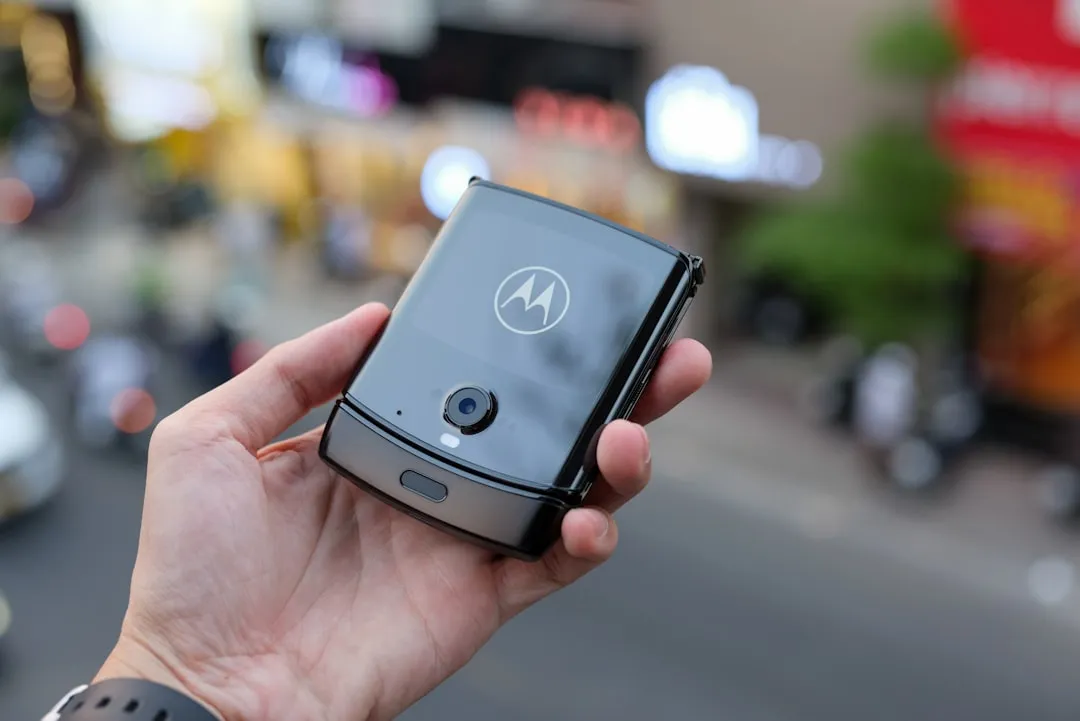
Motorola Razr 70 Colors Leak Shows Fabric and Carbon Textures
A color and finish leak published April 2 suggests the standard Razr 70 will arrive in three Pantone-named options, each with a physically distinct surface treatment. That's the most revealing detail in the Razr 70's pre-launch cycle — not a chipset announcement, not a spec sheet, but a texture.
TENAA listing images suggest the Razr 70 retains nearly the same clamshell silhouette as the Razr 60, with minimal visible design changes between generations, as Xiaomiui reported in mid-March. The hardware reads as a polish pass, not a reimagining: same display class, same charging speed, same overall proportions. Yet the three Razr 70 leaked colors are anything but standard. That combination — familiar form, unusually differentiated surfaces — is the actual story. When the spec sheet doesn't change much, the finish becomes the reason to choose one variant over another, or to choose Razr over the competition at all.
Motorola Razr 70 colors leak: what the leaked finishes actually mean
The three Motorola Razr 70 color options aren't described as standard painted finishes — each reportedly carries a distinct tactile treatment. The Hematite version has a fabric-like texture, the Sparkling Green resembles carbon fiber patterning, and the pink model reportedly has "a different finish altogether," according to GSMArena, which broke the color leak April 2. Worth being clear upfront: these are descriptions from the leak source, not confirmed material specifications from Motorola. The pink finish is the thinnest piece of information in this cycle it exists, but no further detail has been reported.
Pantone co-branding is a consistent element of Motorola's recent design language. Earlier this year, the razr fold also carries Pantone color names as standard practice, GSMArena noted in January. The naming isn't incidental; it positions color as a branded design element rather than a manufacturing variable.
The Razr 70 Ultra follows the same pattern. Leaked renders show a revised fabric texture on the back alongside a new silver finish option, NotebookCheck reported last week. The finish emphasis runs across the entire line, not just the base model.
This is where the flip phone form factor matters. A clamshell isn't handled like a conventional slab. When folded, the Razr is worn and carried the way a wallet or compact is visible in a hand, sitting on a table, pulled from a jacket pocket. You're looking at the outside of the device far more often than you're staring at the screen. Fabric textures affect grip and fingerprint visibility. Carbon fiber-style finishes suggest durability and read differently in a professional setting than polished glass does. These choices shape how the phone feels to own across months of daily use, not just how it photographs in a press render.
Those Motorola Razr 70 Pantone finishes are doing real perceptual and practical work which matters more when the internal specs aren't carrying much of the product story.
What else the pre-launch trail reveals: specs in brief
The clearest hardware upgrade is the camera. The Razr 70 appears to swap the Razr 60's 13MP ultrawide for a 50MP telephoto with 3x optical zoom as the secondary sensor, based on the TENAA listing analyzed by GSMArena and Gizmochina in early March. That's a meaningful capability shift in reach over width, though no sample images exist yet to judge real-world results.
Otherwise, the hardware profile holds steady from the prior generation:
6.9-inch FHD+ foldable OLED, 1080 x 2640 resolution
3.63-inch cover display, 1056 x 1066 resolution
Roughly 4,500mAh dual-cell battery
33W charging
7.2mm unfolded profile, 188g
Up to 18GB RAM, up to 1TB storage
The TENAA listing also reveals an octa-core chip clocked at 2.75GHz, faster than the Razr 60's Dimensity 7400X, which ran at 2.6GHz, but the specific processor remains unidentified, as Yahoo Tech noted in mid-March.
Nothing in that spec sheet demands attention except the camera swap. The rest is maintenance. That makes the finish differentiation matter more, not less. The Razr 70's leaked colors and surface treatments are carrying part of the product story that the specs simply aren't.
Why Motorola's finish strategy makes sense right now
Yahoo Tech, citing IDC data, reports that Motorola accounts for about half of the US foldables market a figure worth reading as directionally meaningful given it comes via a secondary summary rather than the primary IDC report. Even as an approximation, it describes a market leader, not a challenger trying to break through.
A market leader in a maturing category has different incentives than a newcomer. The goal isn't to redefine the product; it's to give existing fans a reason to upgrade and give new buyers a reason to choose Razr over a specification-comparable alternative. Three finishes that look and feel different from each other and from the standard glass and metal options across competing devices is a credible answer to both.
The distinction worth drawing: finishes that affect grip, fingerprint resistance, and perceived durability have genuine ownership implications. A fabric-textured back handles differently in daily use than a glossy one. A carbon fiber-style surface reads differently in a meeting room than a polished metal one. If Motorola's execution is solid, these aren't just marketing choices; they're functional ones.
Execution is exactly what can't be confirmed from leak descriptions alone. "Fabric-like" and "carbon fiber-like" are characterizations from a secondary source. Whether the actual materials hold up over a year of folding, pocketing, and daily handling is a question only the finished product can answer.
What comes next
The Razr 70 color leak is best understood as a signal about Motorola's product logic for 2026: in a cycle where the hardware is iterative, three Pantone-named options with three distinct surface treatments is doing meaningful differentiation work. That's an unusual degree of material variety for a phone that otherwise changes modestly year-over-year, per GSMArena.
The one substantive spec upgrade swapping the ultrawide for a 50MP telephoto with 3x optical zoom suggests Motorola is making considered hardware choices rather than simply refreshing part numbers. The combination of a refined camera spec and a design-led finish strategy is coherent: it targets buyers who want a better-looking, better-shooting flip phone, not a fundamentally different one.
Launch appears imminent. The device has cleared TENAA, 3C, and UAE TDRA certification, and the Razr 60 debuted in April 2025, per Gizmochina. The key unknowns heading into any official announcement are pricing and the chipset — not small details. If the Razr 70 lands at a competitive price point, the design differentiation may be exactly enough to keep it ahead. If pricing steps up without a clear justification beyond finish options and a telephoto lens, that calculus changes quickly.







Comments
Be the first, drop a comment!