



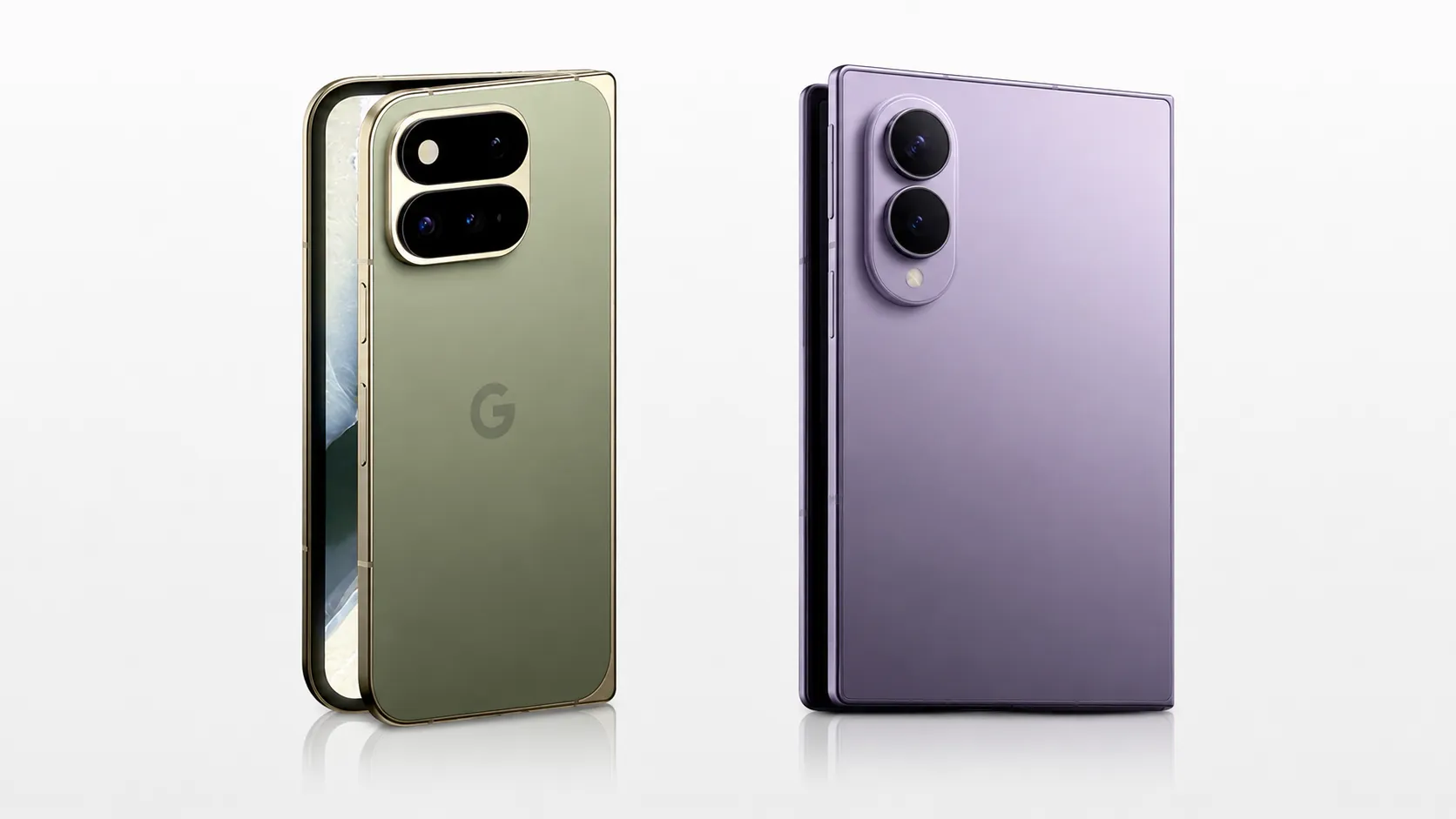
The Google Pixel 11 Pro Fold and Samsung Galaxy Z Fold 8 both start at roughly $1,900, putting them in unusually direct competition. At that price, the more useful question isn't which is cheaper, but what each gives you for flagship-foldable money.
Google starts with several advantages: 16GB of RAM, larger displays, a dedicated 5x telephoto camera, built-in Qi2.2 magnetic charging and an IP68 dust- and water-resistance rating. Samsung counters with dramatically lower weight, faster wired charging and much stronger raw performance.
I'm still picking the Z Fold 8, but the choice is closer than its benchmark advantage suggests.
The Z Fold 8's biggest durability tradeoff
Samsung rates the Z Fold 8 IP48, meaning it is not certified against finer dust or sand. Google's IP68-rated Pixel adds certified dust protection, a meaningful advantage for a device built around a moving hinge.
That difference drew more attention after iFixit tore down the Galaxy Z Fold 8 and gave it a provisional repairability score of 4 out of 10. After exposing its unit to very fine particles and repeatedly folding it, iFixit reported severe grinding from the hinge and problems opening the phone normally.
There's an important qualifier: the experiment was not an official IP-certification test, and the powder was finer than typical beach sand. Trouble with one teardown unit under an aggressive test does not prove normal Fold 8 units will develop the same problem.
Still, Google's IP68 rating gives it the stronger durability story on paper.
Where the Pixel gives you more for $1,900
Google has the more versatile camera setup. The Pixel's 10.8MP telephoto camera offers 5x optical zoom and up to 30x Super Zoom, while the standard Z Fold 8 lacks a dedicated telephoto camera.
The Pixel also has built-in magnets for Qi2.2 charging and Pixelsnap accessories. Samsung supports wireless charging but needs a compatible magnetic case for the same snap-on accessory experience.
Screen size favors Google, too. The Pixel has a 6.5-inch cover display and an 8-inch inner screen, while Samsung uses a 5.5-inch cover display and 7.6-inch inner panel.
Samsung answers with portability. The Z Fold 8 weighs just 201 grams, compared with roughly 239 grams for Google's Fold. That 38-gram difference is substantial for something you carry all day. Google's larger outer screen feels more like a conventional smartphone, while Samsung's shorter, lighter body is easier to hold and pocket.
Charging splits the advantage. Samsung supports 45W wired charging versus Google's 30W, while the Pixel supports up to 25W Qi2.2 wireless charging with its magnets built in.
Samsung has the clear performance lead
This is Samsung's biggest measurable advantage.
In Tom's Guide's Galaxy Z Fold 8 review, the Snapdragon 8 Elite Gen 5 for Galaxy scored 3,659 single-core and 11,020 multi-core in Geekbench 6.
In the publication's separate Pixel 11 Pro Fold testing, Tensor G6 reached 2,687 single-core and 7,381 multi-core.
Synthetic tests don't dictate how responsive a phone feels in every situation, but the gap is large enough to make Samsung the safer choice for demanding games and heavier workloads. Tom's Guide still found the Pixel smooth in everyday use, including app launches and split-screen multitasking.
Battery life is much closer. In the same web-surfing test, the Pixel lasted 12 hours and 31 minutes, versus 12 hours and 19 minutes for the Fold 8. A 12-minute gap is too small to matter in practice.
Pick the Fold 8 for speed, the Pixel for flexibility
Choose the Galaxy Z Fold 8 if raw performance, lower weight, faster wired charging and compact proportions matter most. Its 201-gram body is one of its biggest everyday advantages.
Choose the Pixel 11 Pro Fold if IP68 protection, 16GB of RAM, built-in Qi2.2 magnets, telephoto zoom and larger displays matter more. Its bigger cover screen is also better suited to buyers who want a foldable that still feels like a conventional phone when closed.
Software separates them further. Google adds Fold-specific tools such as sign-to-text, app bubbles, Split Screen and Drag and Drop, while Samsung brings years of large-screen Android refinement to its Multi Window system alongside Galaxy AI features.
Why I'd still buy Samsung
My pick is still the Galaxy Z Fold 8, but not because it wins everywhere.
The Pixel gives you better certified dust protection, more RAM at the base tier, built-in magnetic charging, a dedicated telephoto camera and larger screens. Samsung wins me over with substantially stronger performance, faster wired charging and a lighter design that makes a noticeable difference every time the phone comes out of a pocket.
The IP48 rating keeps this from being an easy recommendation, especially when Google has already reached IP68. But if performance and portability sit at the top of your list, the Z Fold 8 makes the stronger case. If dust protection, camera flexibility, magnetic accessories or maximum screen space matter more, the Pixel 11 Pro Fold is the better buy.






Comments
Be the first, drop a comment!