



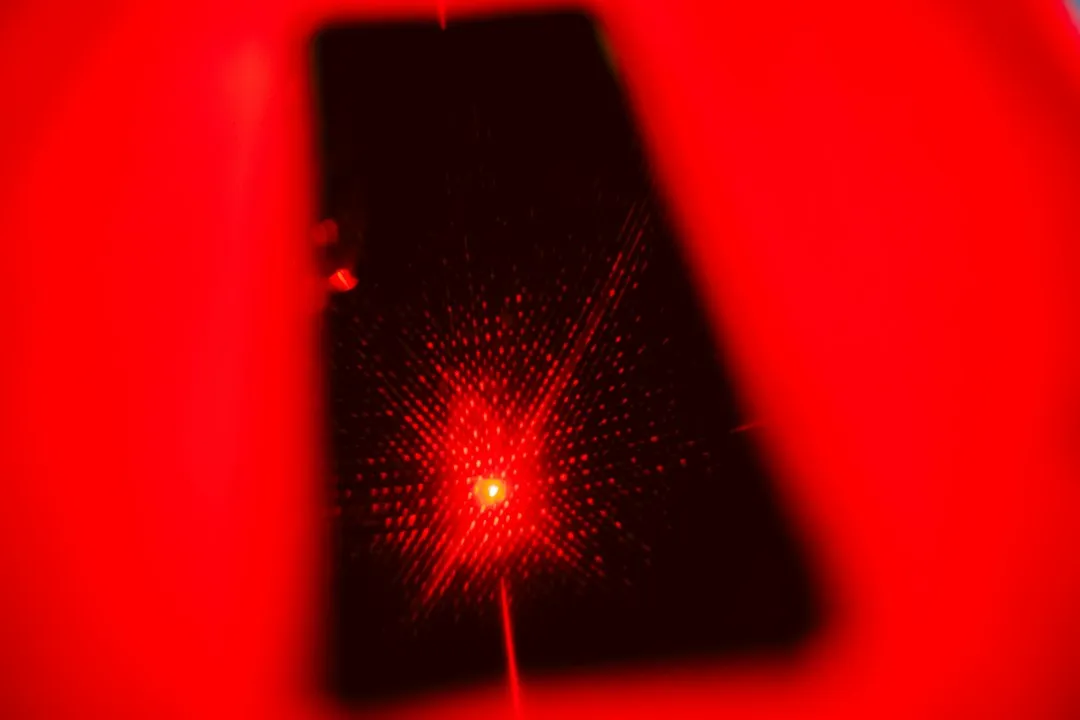
Yes, a laser pointer can damage a phone camera sensor, but the outcome isn't a single fixed result. Research on camera sensors shows effects ranging from temporary overexposure that clears on its own to permanent dead pixels or a sensor that stops producing usable images altogether. None of the studies cited here support the blanket claim that any laser pointer aimed at any phone will wreck the camera. The risk depends on the laser's power, wavelength, exposure duration, and how much energy reaches the sensor.
That nuance matters because much of the published research on laser damage to camera sensors comes from a different context than someone's living room. Researchers testing these thresholds often work on military, surveillance, and counter-drone applications, using pulsed lasers calibrated to specific wavelengths and energy levels rather than ordinary presentation pointers. The camera lens itself can increase the risk: it concentrates incoming laser light onto a small area of the sensor, potentially producing much higher intensity than the beam had before entering the lens.
This article covers what laser damage to a phone camera looks like, how that damage happens at the sensor level, what the research says about whether modern sensors hold up better, and how to check a suspicious photo before assuming the worst.
Can a laser pointer permanently damage a phone camera?
Researchers studying laser-sensor interactions distinguish temporary dazzling from permanent damage. As laser intensity rises, a camera can move from an overexposed image that recovers to lasting changes in how individual pixels respond to light, and eventually to extensive damage that makes the sensor unusable.
Laboratory testing backs that progression with specific damage categories, though the results come from focused pulsed-laser exposure on test sensors, not consumer pointers aimed at actual phones.
In a 2022 study published in Sensors, researchers used a Q-switched Nd laser at 532 nanometers to expose CCD and CMOS camera sensors. They documented outcomes ranging from single-pixel defects to multi-pixel clusters, row-or-column line damage, and, at sufficiently high exposure levels, widespread sensor failure.
Recovery speed is where real-world confusion starts. A 2025 counter-drone study reported that CMOS sensors recovered from temporary dazzling in roughly 10 to 20 milliseconds, while CCD sensors took around 200 to 300 milliseconds under the tested conditions.
A flash of overexposure that disappears almost immediately is consistent with temporary dazzling rather than lasting damage. However, those recovery times are specific to the tested equipment and shouldn't be treated as universal measurements for smartphone cameras.
What does laser damage to a phone camera look like?
When sensor damage is permanent, it can show up as a persistent artifact in photos rather than a glitch that clears after a reboot. Laboratory tests exposing silicon imaging sensors to focused laser pulses documented single-pixel defects, larger multi-pixel clusters, and line damage running along a row or column of the sensor, with widespread sensor failure at the extreme end.
A separate study using a 1550-nanometer nanosecond laser on a silicon-based CMOS image sensor found a similar pattern: point damage, line damage, and cross damage, depending on the laser's pulse characteristics and exposure conditions, according to research published in Optics Express in 2024.
The studies used different wavelengths and experimental setups, but both documented localized and more extensive damage patterns. Neither tested a complete smartphone camera module.
Outdoor testing also demonstrates that permanent pixel damage can occur outside controlled laboratory conditions, though with specialized equipment far removed from a consumer pointer.
A 2023 long-range CMOS experiment exposed a commercial visible-band camera to a 532-nanometer pulsed laser from approximately 1.5 kilometers away. The researchers reported substantial permanent pixel damage under the tested conditions.
That confirms permanent damage is possible outside the laboratory, but it doesn't establish what an ordinary handheld laser pointer would do to a phone camera.
For anyone checking their own phone, the practical distinction is persistence. A flash that overexposes one photo and clears by the next shot is consistent with temporary dazzling. A colored dot, dark spot, or line that appears in the same position across multiple photos taken in different lighting may indicate lasting sensor damage worth investigating.
How laser light actually damages a camera sensor
The mechanism starts with the lens, not just the sensor itself. A phone's camera lens gathers and focuses light, and it can focus laser light just as it focuses light from an ordinary scene.
Researchers compare the concentrating effect to a magnifying glass focusing sunlight onto a small point. A laser beam entering the camera can be concentrated onto a much smaller area of the sensor.
That focused spot can receive far more energy per unit area than the original beam. The amount of concentration depends on the lens, the beam, and the sensor geometry. At sufficient intensity, absorbed energy can damage the sensor's photosensitive structures or electrical circuitry, creating permanent defects.
The 2022 Sensors study describes several mechanisms that can contribute to damage, including localized heating and electrical disruption. Depending on the exposure, the result may affect individual pixels, groups of pixels, or larger parts of the sensor.
Wavelength and timing also change the threshold at which damage occurs. Sensors absorb different wavelengths with different efficiencies, so a laser's wavelength affects how much of its energy reaches and is absorbed by sensitive structures.
Pulse width and repetition rate matter too. The 2024 Optics Express study found that repetition rate, pulse duration, and total exposure time influenced damage patterns and thresholds under its experimental conditions.
Infrared light deserves a specific caveat rather than a blanket assumption of safety. The 2022 study included limited testing at 1064 nanometers and found that the tested visible-band CMOS sensor required greater exposure to produce initial damage at that wavelength than at 532 nanometers.
The researchers associated the difference partly with wavelength-dependent absorption and optical filtering. That's not a guarantee of protection across every infrared wavelength or camera design.
Treating infrared lasers as automatically harmless isn't supported by the research. Some infrared wavelengths are also invisible to the human eye, making exposure especially difficult to recognize.
Are modern phone sensors more resistant to laser damage?
Testing across three sensor architectures, charge-coupled devices (CCD), front-side illuminated CMOS (FSI CMOS), and back-side illuminated CMOS (BSI CMOS), found substantial differences in how much laser energy was needed to cause catastrophic sensor failure under laboratory conditions.
In the 2022 Sensors study, BSI CMOS sensors were the most resistant to large-scale damage. The researchers reported sensor-wide failure at approximately 1,000 joules per square centimeter for BSI CMOS, compared with about 10 joules per square centimeter for FSI CMOS and roughly 1.6 to 2.7 joules per square centimeter for CCD sensors.
Those figures describe the tested sensor architectures under specific pulsed-laser conditions, not the amount of laser energy an actual smartphone camera can safely withstand.
The paper suggests the difference may be related to the placement of electronic circuitry in BSI sensors. Their structure can offer greater protection against the effects of intense laser exposure.
However, the study didn't test a complete smartphone camera module, and its findings don't establish a damage threshold for any particular iPhone or Galaxy model.
That survival gap also matters less than it initially sounds for a single stray laser hit.
The same laboratory testing found that the threshold for initial permanent pixel damage was broadly similar across all three sensor architectures. The average exposure associated with a 95% probability of damage was approximately 0.077 joules per square centimeter at 532 nanometers under laboratory conditions.
That figure is a measured threshold for the tested sensors, not a general phone-camera limit.
A tougher sensor architecture may help prevent catastrophic failure, but the study doesn't show that it reliably prevents the first permanent pixel defect.
The bigger gap in this research is what it never tested. None of the studies cited here directly tested ordinary presentation pointers against complete smartphone camera modules at typical indoor distances.
The main numerical thresholds come from specialized laser experiments, many involving Q-switched or nanosecond pulsed lasers developed for military, surveillance, or counter-drone applications.
Other published research has examined continuous-wave laser exposure, but those results also depend on the specific sensors, wavelengths, optical systems, and exposure durations involved. They don't provide a universal safe exposure limit for smartphones.
Whether a laser can damage an iPhone camera, a Galaxy camera, or another phone follows the same underlying physics regardless of brand. The outcome depends on the laser's characteristics and the amount of energy delivered to the sensor, not simply which company made the phone.
The available evidence doesn't establish a universal threshold matching an ordinary laser pointer against a phone camera at typical distances. Claims that all pointers are harmless, or that every exposure causes permanent damage, go beyond what these studies demonstrate.
How to check if a laser damaged your phone camera
A suspicious photo is worth checking carefully before jumping to conclusions.
If a phone has multiple rear cameras, test each one separately rather than assuming a mark on one image means every camera is affected. Select one camera, keep the same zoom setting, and photograph something evenly lit and relatively featureless, such as a blank wall.
Uniform backgrounds make small defects easier to notice than busy scenes.
Look for a spot, cluster, line, or cross-shaped mark that stays in approximately the same position across multiple shots taken in different lighting. A persistent sensor defect may repeatedly affect the same area of the image.
Keep in mind that zoom, cropping, stabilization, and computational processing can change where a mark appears or how large it looks in a saved photo. Compare images taken with consistent settings rather than switching between lenses or zoom levels.
Before concluding it's sensor damage, rule out two common false alarms.
First, inspect and gently clean the camera lens. Smudges, dirt, scratches, or damage to the camera cover glass can create visible artifacts. Their appearance may change with lighting, focus, or the angle of the light.
Second, view the photos on another device. If the mark appears only on the original phone's screen rather than in the saved image, the display may be responsible.
A mark that remains visible in saved images across different lighting conditions, after the lens has been cleaned, is consistent with a camera problem.
That isn't proof of laser damage. Similar symptoms can have other causes, and confirming the underlying fault may require inspection by the manufacturer or a repair technician.
What to do if you suspect laser damage to your phone camera
If a persistent artifact survives those checks, save example photos and contact the phone's manufacturer or an authorized repair provider.
Don't assume a software update or restart will repair physically damaged sensor pixels. When permanent sensor damage is the cause, the problem is hardware-related and may require replacement of the affected camera module.
Avoid intentionally pointing laser pointers at a camera to test what happens. The same concentrated light that can damage imaging sensors may also pose an eye hazard.
None of the studies cited here establishes a universal damage threshold for ordinary presentation lasers aimed at smartphone cameras at typical indoor distances.
Until that gap is addressed by testing on actual phone camera modules, the safest approach is straightforward: keep laser beams away from camera lenses and eyes, check suspicious photos using the steps above, and have persistent artifacts assessed professionally rather than diagnosing laser damage from a single image.






Comments
Be the first, drop a comment!