





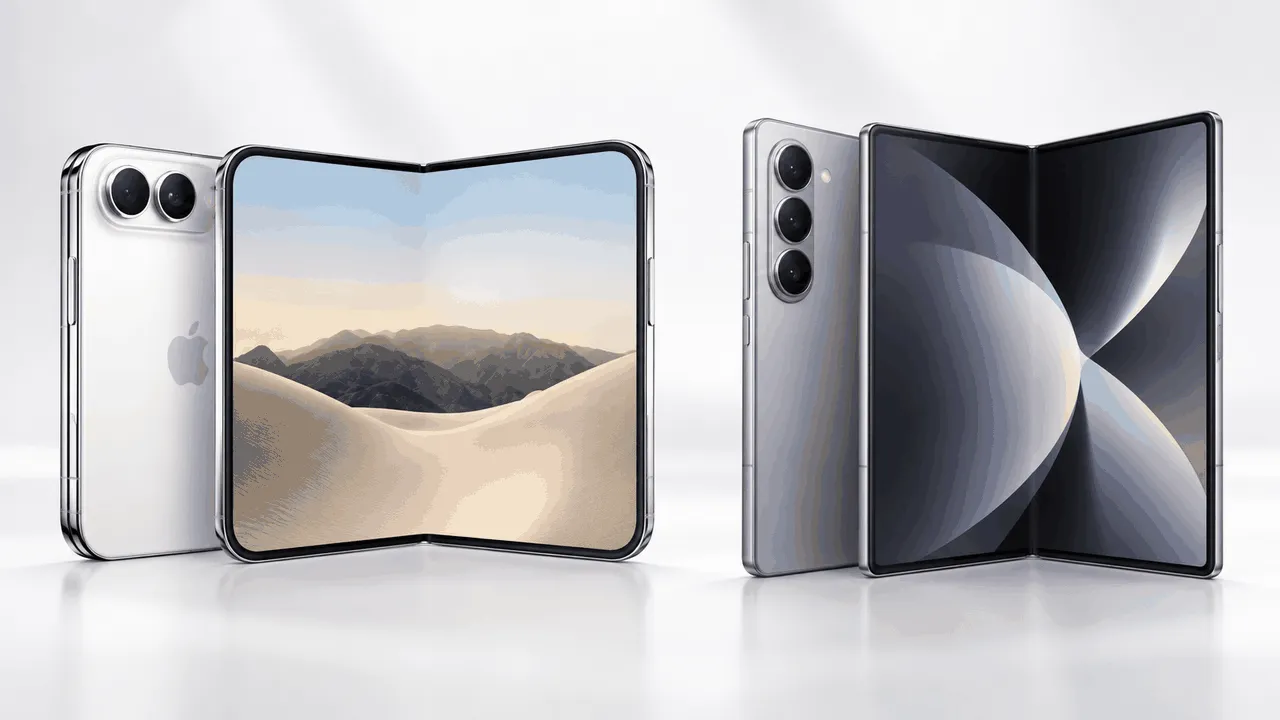
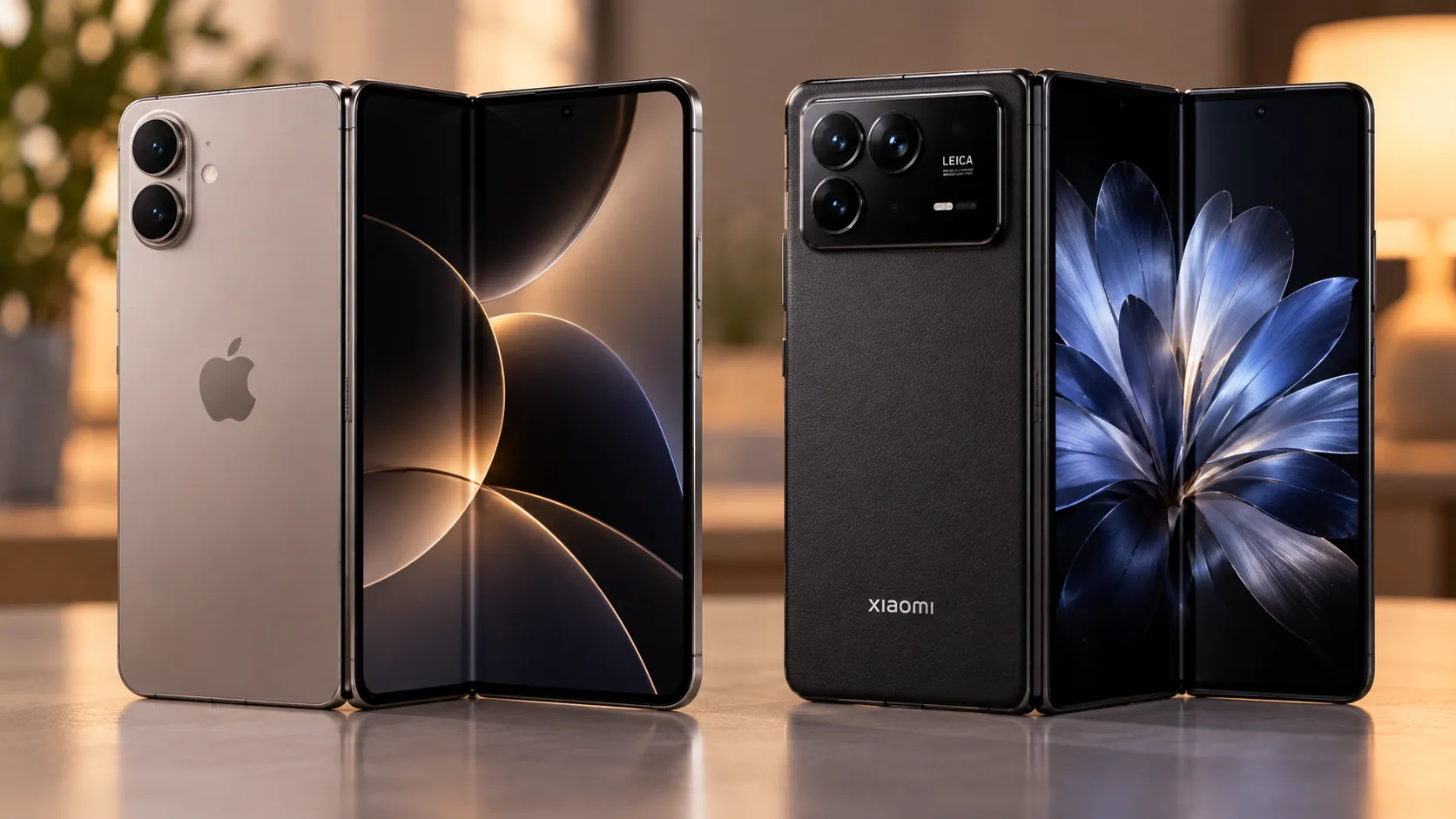
Apple has finally unveiled its first foldable phone, and the shape looks strangely familiar. The book-style design, 7.6-inch inner display, and 3,000-nit peak brightness Apple announced this week land close to where Samsung already sits with the Galaxy Z Fold 8, a phone The Verge put through a week of testing. That overlap is the starting point for any iPhone Duo vs Samsung Galaxy Z Fold 8 comparison: Apple has arrived at a form factor Samsung has already priced and had independently reviewed.
The iPhone Duo starts at $1,999 for 256GB, with preorders opening October 16 and availability beginning October 23, according to PetaPixel. The Galaxy Z Fold 8 starts $100 lower at $1,899.99 and already carries an Editors' Choice award from PCMag, whose reviewer spent a week with the phone about six weeks ago and called it "the foldable to beat."
That gap in testing time matters for anyone weighing the two. Everything Apple has said about the Duo so far is a claim made at an announcement event; no independent hands-on testing of the phone is available yet. The Fold 8, by contrast, already has weeks of independent battery testing, benchmark results, and camera assessments behind it. This comparison lays out what's confirmed on both sides, what's still marketing language, and what to check before spending $1,999 or more.
iPhone Duo vs Galaxy Z Fold 8 specs: what's confirmed
Starting price
iPhone Duo: $1,999 (256GB)
Galaxy Z Fold 8: $1,899.99 (256GB)
Inner display
iPhone Duo: 7.6-inch, 3,000 nits; crease claimed to be "virtually imperceptible"
Galaxy Z Fold 8: 7.6-inch LTPO AMOLED, 1,848 x 2,448, 3,000 nits
Outer display
iPhone Duo: 5.4-inch, 3,000 nits
Galaxy Z Fold 8: 5.5-inch LTPO AMOLED, 120Hz, 3,000 nits
Folded dimensions and weight
iPhone Duo: 84.1 x 117.8 x 11.3mm folded, 254g
Galaxy Z Fold 8: 123.9 x 81.9 x 9.7mm, 201g
Water/dust rating
iPhone Duo: IP68
Galaxy Z Fold 8: IP48
Chipset
iPhone Duo: A20 Pro
Galaxy Z Fold 8: Snapdragon 8 Elite Gen 5 for Galaxy
RAM
iPhone Duo: Not disclosed
Galaxy Z Fold 8: 12GB or 16GB
Storage
iPhone Duo: 256GB, 512GB, 1TB, 2TB
Galaxy Z Fold 8: 256GB, 512GB, or 1TB
Rear cameras
iPhone Duo: 48MP main + 48MP ultrawide
Galaxy Z Fold 8: 50MP main + 50MP ultrawide
Battery
iPhone Duo: Up to 44 hours using the outer display only / 24 hours using both screens
Galaxy Z Fold 8: Up to 26 hours claimed; nearly 17 hours in PCMag testing
SIM
iPhone Duo: eSIM only
Galaxy Z Fold 8: Nano-SIM + eSIM, or dual eSIM
Stylus
iPhone Duo: Apple Pencil support "later this year"
Galaxy Z Fold 8: No S Pen support
Software support
iPhone Duo: Not announced
Galaxy Z Fold 8: Samsung says seven years of OS and security updatesLook past the marketing copy and the two phones sit closer together than either company wants to admit. Both use a passport-style shape, both top out at 3,000 nits, and both landed on a 7.6-inch inner panel. Apple's outer display is 5.4 inches against Samsung's 5.5, close enough that it probably won't decide anything on its own.
Where the sheets diverge is in what's missing. Samsung has published folded dimensions and a weight that Android Central lists as the lightest Z Fold Samsung has made at 201g. Apple lists the Duo at 84.1 x 117.8 x 11.3mm folded and 254g, making it thicker and heavier than the Fold 8 on paper.
The chipset picture runs into a similar wall. Apple's A20 Pro also powers the iPhone 18 Pro line, but no independent Geekbench results for the Duo exist ahead of the October 23 launch, so there's nothing yet to set against the Fold 8's Snapdragon 8 Elite Gen 5 scores of 3,136 single-core and 8,975 multi-core, recorded by PCMag. Storage tells a similar story. Samsung confirms tiers up to 1TB with 16GB of RAM, while Apple lists the Duo in 256GB, 512GB, 1TB, and 2TB capacities, although its announcement gives only the $1,999 starting price. The SIM setup is a clearer trade-off: the Fold 8 supports a physical nano-SIM alongside eSIM, or dual eSIM, while the Duo drops physical SIM entirely, which Apple says frees up internal space for battery capacity.
Design and durability: whose passport-shaped foldable holds up
Apple's most concrete advantage on paper is IP68 dust and water resistance, a rating the Fold 8 doesn't match. The Fold 8 carries IP48, and The Verge's own reviewer flagged that as a real gap after hands-on use, noting it leaves the phone more vulnerable to dust and sand than foldables from Google, Oppo, and Honor. That's an independent assessment, not a company admission, and it's the strongest evidence favoring Apple's durability claim right now.
The crease comparisons are murkier. Apple says its Nano Texture display technology, borrowed from high-end Mac and iPad screens, makes the Duo's fold "virtually imperceptible." On the Samsung side, PCMag reports that Samsung credits a dual-layer hinge structure called Flex Titanium with flattening what used to be a visible trench into what the reviewer describes as a "subtle seam," while Android Central's spec sheet for the Fold 8 simply lists the inner display as "crease-less." Neither company's crease claim has been tested long-term; the cited reviews cover one to two weeks of use, not months of repeated folding.
Samsung's hinge has a documented limitation Apple could exploit if the Duo performs differently. Android Central found the Fold 8's hinge can't be freely adjusted to hold different angles, especially beyond 90 degrees, and it skips the Flex Mode panel found on Samsung's own Fold 8 Ultra and Flip 8. Apple says the Duo's hinge is built from more than 100 components, but whether that produces better angle control or a longer folding lifespan is unverified until independent reviewers can test one.
There's a usability upside worth noting on Samsung's side, too. Both The Verge and PCMag point to the Fold 8's 4:3 inner display as better suited to reading and video than the taller, narrower panels on older Z Folds, and The Verge's week-long test found app compatibility issues on the short outer screen are rare rather than routine. Whether the Duo's dual displays handle everyday apps as smoothly is something no reviewer has been able to check yet.
Apple's new CEO, John Ternus, took a direct shot at the category, saying rival foldables "feel like two phones awkwardly stuck together," per PetaPixel. That's Apple's framing, and it doesn't line up cleanly with what reviewers found using the Fold 8. After a week of daily use, The Verge described it as "comfortable, natural, and normal," despite calling it the shortest, widest phone the reviewer had used.
Cameras, battery, and software support: where the money goes
Both phones landed on two rear lenses with no dedicated telephoto lens, a step down from what flagship buyers might expect at this price. The Duo pairs a 48MP Fusion Main camera with a 48MP Fusion Ultra Wide, the same sensors used in the iPhone 18 Pro, and uses the 48MP main sensor to produce a 12MP 2x image that Apple calls "optical-quality" Telephoto.oc
Megapixel counts alone don't settle much, though. The Verge's testing found the Fold 8's new main camera actually uses a smaller sensor, lower resolution, and narrower aperture than last year's model, calling it worse in just about every respect, while the ultrawide lens was a genuine improvement. That's a useful caution for judging the Duo's specs too: a matching megapixel count doesn't guarantee equal image quality, and independent testing will show how Apple's sensors actually perform in practice once units ship.
Apple is leaning on features that only a foldable can offer, not just sensor specs. PetaPixel reports the Duo can record from both the rear and front-facing cameras simultaneously while unfolded, with a framing preview visible on the outer display, shoot 4K120 video in Dolby Vision with Cinematic effects added after capture, and use its folded shape as a built-in stand for what Apple describes as smart-tripod-style shooting. None of that has been tested outside Apple's own demo yet, but it's a genuine differentiator on paper that the spec sheet alone doesn't capture.
Battery comparisons aren't directly comparable either. Apple claims up to 44 hours of video playback using the outer screen alone, or 24 hours splitting time between both displays. Samsung claims 26 hours under its own video-playback test, but PCMag's independent battery rundown measured the Fold 8 at nearly 17 hours, a meaningful gap between company estimate and real-world result. These aren't apples-to-apples figures to begin with, since Apple splits its claim across two display-use scenarios and Samsung's is a single number. The Fold 8 also uses a silicon-carbon battery; The Verge notes that chemistry can degrade faster over time than older designs, though Samsung says it engineered around that risk. On charging, the Fold 8 lacks the built-in magnets for Qi2 wireless charging that Google's Pixel 10 Pro Fold has, though it works fine with Qi2 cases. There's no independent Duo test to compare against any of this, so Apple's battery numbers should be read as a starting estimate, not a settled fact.
Pricing tiers favor Samsung's transparency. The Fold 8 runs from $1,899.99 for 12GB of RAM and 256GB of storage up to $2,499.99 for 16GB and 1TB, a clear ladder of options. Apple's announcement materials list only the $1,999, 256GB starting configuration, with no pricing disclosed for anything higher.
Software support may end up being the most consequential gap between the two. Samsung said it will offer seven years of OS and security updates for the Fold 8, matching Google's stated commitment for the Pixel 10 Pro Fold and beating Motorola's four-year promise for the Razr Fold, according to PCMag. Apple has not announced a Duo-specific support period.
iPhone Duo or Galaxy Z Fold 8: which buyer should choose each?
Stylus support looks like a wash rather than an advantage for either phone at launch. The Fold 8 doesn't support the S Pen at all, according to Samsung. Apple says Pencil support is coming to both Duo displays, but only "later this year," not at the October 23 launch. Neither phone is a day-one stylus choice.
Multitasking is where Samsung's head start is clearest. The Fold 8 already supports three-app side-by-side layouts and customizable multi-window views in One UI 9, tested directly by Android Central over two weeks of daily use. Apple has redesigned iOS 27 around the Duo's dual-screen layout, but that interface has only appeared in Apple's own demo so far, with no independent hands-on time yet to confirm how it behaves day-to-day.
Buy the Fold 8 now if: a foldable is needed immediately, physical SIM flexibility matters, or a stated seven-year update window and tested multitasking features are priorities. It's a known quantity: an Editors' Choice award, a measured battery result, published Geekbench scores, and a 3DMark Wild Life Extreme result of 4,213 frames (25.23 fps) already on record. Anyone switching from an iPhone should also check compatibility first: Samsung's upgraded transfer tool requires Android 17 with One UI 9 on the Galaxy side and iOS 26.6 or later on the iPhone being replaced.
Wait for the Duo if: staying in iOS matters, Apple's dual-camera recording and video features are appealing, or there's enough patience to wait for independent battery, crease, hinge, and durability testing. The Duo carries a list of confident claims from Apple's announcement and nothing else to verify them yet.
What to do now
If a foldable is needed today, the Galaxy Z Fold 8 is the safer purchase: a lower entry price, independently tested battery performance, confirmed multitasking, and a support commitment that matches Google's Pixel promise. Its documented weaknesses are on the record too, including an IP48 rating behind Apple's claimed IP68, no telephoto lens, and a hinge that resists holding angles past 90 degrees.
Anyone drawn to the Duo should treat Apple's specs as a starting point, not a verdict. Preorders open October 16 and availability begins October 23; independent reviews around launch should provide testing of the crease, battery life against Apple's 44- and 24-hour claims, and compare Apple's IP68 rating against the kind of independent dust-and-sand testing the Fold 8 has already been through. Until those reviews land, the $1,999 price carries real uncertainty because the performance and durability claims behind it are still untested.






Comments
Be the first, drop a comment!