



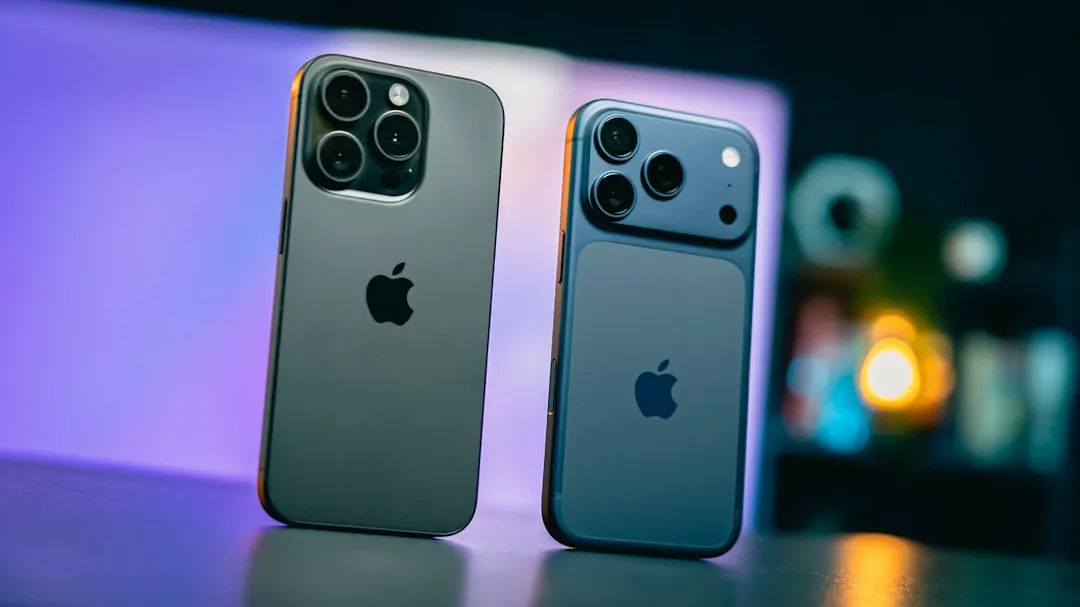
Apple iPhone post-holiday smartphone sales: what Q1 2026 reveals
The headline number from Q1 2026 isn't which vendor shipped the most smartphones. It's that global smartphone revenues climbed 8% year-over-year even as total unit shipments barely budged. Counterpoint Research reported this week that Apple was the fastest-growing vendor in that revenue-led environment. Apple iPhone post-holiday smartphone sales look stronger than the unit tables alone suggest, and understanding why requires looking past the shipment rankings.
Q1 beat expectations. That doesn't mean the year looks safe. IDC projected earlier this year that total worldwide shipments will fall nearly 13% in 2026 to 1.1 billion units, the steepest annual drop on record, driven by a memory supply chain shock the firm called a structural reset rather than a temporary squeeze. Omdia data from last week showed Q1 global shipments coming in above expectations at 1% growth, but flagged explicitly that the second-half outlook remains uncertain. The full force of the disruption IDC forecast hasn't landed yet.
What follows examines what the Q1 2026 shipment and revenue data actually shows, using market tracker reports from Counterpoint, IDC, and Omdia rather than retail sell-through figures, which aren't yet available. The argument: Apple's post-holiday momentum is most usefully understood as evidence that a harsher market is concentrating gains at the premium end, and the iPhone 17 lineup was well suited to capitalize on exactly that environment.
Why this market rewards premium vendors and penalizes everyone else
The memory shortage IDC described isn't hitting all vendors equally. Low-end Android manufacturers face sharply rising component costs they must either absorb, crushing margins, or pass through to buyers who are already price-sensitive. IDC vice president Francisco Jeronimo put it plainly: vendors at the low end "will have no choice but to pass the costs on to end users." IDC explicitly identified Apple and Samsung as better insulated from the squeeze, capable of not just weathering the disruption but potentially expanding market share as smaller competitors struggle with the arithmetic of cost inflation at volume.
The numbers are stark. IDC projects the global smartphone average selling price will rise 14% in 2026 to a record $523, even as total volume falls by roughly 150 million units. Any vendor operating well above that average, which Apple reliably does, benefits structurally from that divergence. The gap between unit volume and revenue growth isn't a quirk of one quarter; it's the shape of the market right now.
Apple and Samsung's combined share of the global market reached 39% in 2025, up from 37% the prior year, according to IDC. IDC attributed that two-point gain directly to accelerating premiumization, noting that consumers were gravitating toward higher-end devices as the broader market softened. The trend predates the memory crisis. The crisis is now accelerating it.
Samsung benefits from this dynamic too, though its position is more complicated than Apple's. Its Galaxy Z Fold and S-series flagships sit comfortably in premium territory, but its Galaxy A-series budget line, which IDC noted drove Samsung's strongest Q4 growth since 2013, creates exposure to exactly the cost pressure squeezing the rest of the industry. Those same devices are now the product tier most vulnerable to rising component costs. Apple doesn't have that exposure. Its entire lineup sits at price points where a $20 or $30 cost increase doesn't reset the purchase decision the way it does at $199.
The practical implication for anyone tracking this market: fewer cheap smartphones will get made, mid-range buyers will face higher prices, and the brands with established premium positioning gain pricing power without needing to discount. That structure favors Apple more cleanly than it favors anyone else.
Apple vs Samsung smartphone shipments in Q1 2026
Being precise about what Apple led and what it didn't is where this analysis gets useful.
On quarterly unit shipments, Samsung held the top position. Omdia's tracker last week put Samsung at 65.4 million units in Q1 2026, up 8% year-over-year, versus Apple at 60.4 million, up 10% YoY. Apple shipped fewer phones. It grew faster in percentage terms, and that growth was concentrated at price points where each unit generates significantly more revenue. On revenue growth across the quarter, Counterpoint Research identified Apple as the fastest-growing major vendor in a period when global smartphone revenues rose 8% despite a shipment slowdown.
The annual context matters here. IDC confirmed earlier this year that Apple held the top annual shipment position for the third consecutive year in 2025, with record-high full-year volumes and its best Q4 performance since 2021. That's the trendline Q1 2026 is extending, not reversing.
Unit count, revenue growth rate, and annual share are three different scorecards. Apple did not lead Q1 in units. It did grow faster by revenue in a quarter when pricing mattered more than raw volume. Those aren't contradictory results; they're a precise description of what's happening competitively.
Omdia's finding that Samsung retained the quarterly unit lead against industry expectations is worth pausing on. The expectation was apparently that Apple might close the gap further on volume. It didn't, at least not to the point of overtaking. But Samsung's Q1 unit lead, while real, comes with an asterisk: its broader product range means more of those 65.4 million units sit in price tiers that are about to get squeezed. Apple's 60.4 million units are concentrated where margins hold. That distinction will matter more as the year progresses.
The gap between unit rank and revenue rank is widening across the smartphone industry, not just at the Apple-Samsung level. Tracking both metrics, and understanding why they diverge, is how to read global smartphone sales Q1 2026 data clearly rather than cherry-picking the number that tells a more convenient story.
How the iPhone 17 lineup drove Apple's Q1 performance
Apple's Q1 results weren't an accident of favorable conditions. They were driven by a product strategy running across multiple tiers and geographies simultaneously. Omdia identified the iPhone 17 series as Apple's primary growth driver in Q1, with two distinct contributors: the flagship Pro models and the newly introduced iPhone 17e.
At the high end, the iPhone 17 Pro and Pro Max outpaced their predecessors at launch. The most striking regional result came from China, where those flagship models recorded 42% YoY growth compared to the equivalent prior-generation launch period, according to Omdia. At the more accessible tier, the iPhone 17e delivered a strong debut in carrier-driven markets, particularly the EU and Japan, where telco subsidies reduce the upfront cost and upgrade cycles follow operator promotions. That model extends Apple's reach into segments where the full flagship price is a barrier, without pulling down the Pro lineup's positioning.
China requires careful reading. The overall Chinese smartphone market contracted 3.3% YoY in Q1 2026 to roughly 69 million units, according to IDC's China Q1 analysis. Results came in slightly above analyst expectations, driven largely by Huawei and Apple competing in the premium segment where spending held up as the broader market softened. The same IDC analysis notes that sustained iPhone 17 demand was constrained by insufficient supply, which capped how much of that consumer appetite converted to actual shipments. Apple's China performance is real, but the full upside may not be visible until inventory normalizes.
The China picture also carries a competitive caveat that's easy to understate. Huawei's domestic position is not a secondary concern. It is a formidable competitor in the same premium segment where Apple is growing, with nationalist purchasing sentiment providing a tailwind that no amount of product refinement can fully offset. Apple's 42% YoY Pro growth in China is impressive; it's also happening in a contracting market against a competitor that benefits from advantages Apple cannot replicate. Both things are true.
Apple's own Q1 2026 earnings release described it as the company's "best-ever quarter," driven by "unprecedented demand" with "all-time records across every geographic segment." That language confirms the direction of travel, though Apple doesn't publish unit shipment figures in its earnings release. The competitive picture, how Apple performed relative to the market and to its peers, comes from the Omdia, IDC, and Counterpoint data, not from Apple's own characterization of its results.
What to watch in the second half of 2026
Q1 was a strong quarter. It is not a verdict on the full year, and the data doesn't support reading it as one.
The memory shortage IDC characterized as a structural reset hasn't yet fully materialized in quarterly results. Omdia was explicit that the second-half outlook remains uncertain, which means Apple's favorable Q1 conditions haven't yet faced the full force of the disruption IDC forecast earlier this year. Three variables are worth tracking concretely as Q2 and Q3 data arrives.
The first is China supply normalization. If iPhone 17 demand there was genuinely constrained by inventory rather than softening consumer willingness to spend, restoring supply should convert that latent demand into shipments in subsequent quarters. If Q2 and Q3 data show continued Chinese market contraction even with better availability, the demand story needs reassessment. Huawei's competitive position provides a credible alternative explanation, and the IDC China data doesn't currently let us cleanly separate "supply-constrained Apple demand" from "Huawei taking share."
The second is iPhone 17e durability in carrier markets. The EU and Japan debut was strong, but first launch quarters for new sub-lines often overstate sustained performance as early adopters and pent-up upgrade cohorts clear quickly. Whether European and Japanese telcos maintain promotional support into the second half will indicate whether Apple has genuinely expanded its addressable base or front-loaded a single cycle.
The third is low-end Android price behavior, and this one has implications beyond Apple specifically. If budget Android vendors are forced to raise prices meaningfully in response to rising memory costs, buyers in the $200-$400 range face a choice: absorb the higher price, trade up, or defer. Deferral shrinks the total market. Trading up, even partially, benefits Apple and Samsung. Tracking mid-range ASP movements through the year will clarify which dynamic is dominant.
IDC projects a modest 2% recovery in 2027 followed by a stronger 5.2% rebound in 2028 as the supply chain stabilizes. That timeline concentrates the window for premium consolidation in 2026 itself, the trough year, before volume recovers and competitive pressure from resurgent budget vendors intensifies again.
Apple entered that window carrying real momentum. The question the full-year data will answer is whether Q1's revenue leadership reflects a durable structural shift in how consumers prioritize spending on smartphones, or whether it reflects a specific product cycle, favorable post-holiday timing, and supply conditions that won't repeat in the same configuration. Those explanations aren't mutually exclusive, but the ratio between them matters enormously for how Apple's 2026 market position gets interpreted. A premium-share gain built on genuine consumer preference is a lasting asset. One built on a competitor's temporary supply problems and a strong launch window is a data point, not a trend.
The unit tables will keep ranking Samsung first on quarterly volume for the foreseeable future. The more interesting number to watch is whether the revenue gap between Apple and the rest of the field continues to widen even as shipment counts stay close. If it does, the premiumization thesis holds. If revenue growth rates converge as the year progresses, the Q1 story will need a more careful retelling.






Comments
Be the first, drop a comment!