



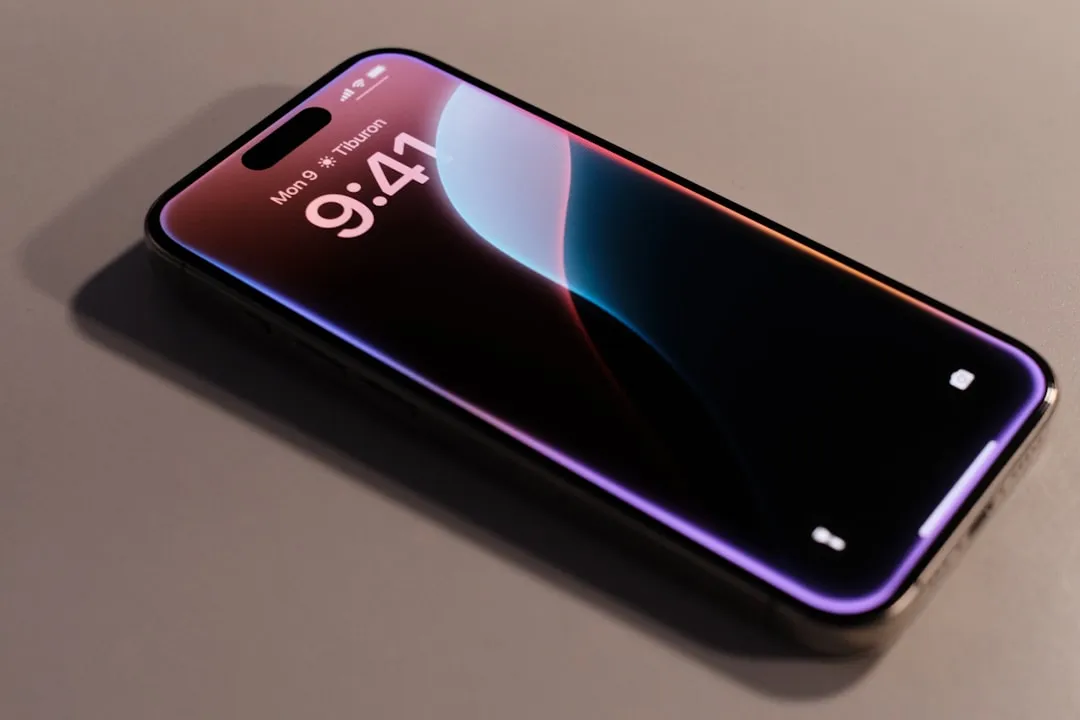
Recent leaker and supply-chain reports point to Apple developing a Samsung-developed micro-curved OLED panel for its 20th-anniversary iPhone, targeting a bezel that effectively disappears from the user's line of sight rather than simply measuring smaller.
Multiple leaker and supply-chain reports describe a 2027 iPhone quad-curved OLED display concept built around optical engineering, with the panel curving subtly on all four sides, MacRumors reported in April, citing leaker and supply-chain claims. What remains genuinely unresolved is whether under-display Face ID and camera technology will clear Apple's quality bar before a fall 2027 launch. Production has not been confirmed.
Some coverage has described "production testing underway." The sourcing does not support that. What it shows is active concept development and supplier engagement. Confirmed prototype builds, engineering validation testing, and manufacturing line activation are distinct stages, none of which appear in the current evidence base.
The display concept: how a bezel-less 2027 iPhone display might actually work
The clearest technical framing comes from leaker Ice Universe, who posted on X that the design is "not a traditional quad curved display, nor is it anything like the curved screen solutions we have seen on Android phones over the years." The visual effect, he wrote, may come from "a sophisticated combination of optical refraction, light guiding structures, and carefully engineered visual illusion" rather than panel bending.
That framing lines up with a more categorical statement that the same source posted last August. Apple had explicitly told suppliers it would not adopt curved screens. The most ambitious result for the 2027 model might be a "visual curve" effect, similar to how Apple Watch glass arcs gently at the edges while the active display panel underneath stays flat, according to BGR. The glass bends; the OLED surface may not.
Supply-chain reporting from Korean outlet Dealsite describes the physical construction in more specific terms: display circuitry bent around all four edges, protected by an ultra-thin film encapsulation (TFE) layer that seals the OLED stack against moisture and air, as MacRumors previously reported. The panel is described as an "equal-depth" micro-curved flexible AMOLED, meaning the curvature is shallow and uniform across all four sides rather than the pronounced waterfall bend that defined Samsung's Galaxy Edge phones.
The panel is also reported to use Samsung's COE (Color Filter on Encapsulation) technology. COE is a polarizer-free architecture that places the color filter directly on the encapsulation layer rather than adding a separate polarizer film, producing a display that is both thinner and brighter, MacRumors reported last month, with OLED-Info reporting the same around the same time.
There is a specific engineering risk in this construction. If the TFE layer and the optical clear adhesive (OCA) applied at the curved edges are not calibrated precisely, the curvature produces a subtle "magnifying glass" artifact, a distortion visible from the side of the device, BGR noted in that same August report. The issue may be solvable, but it illustrates why this design is more demanding than simply bending a panel.
The rumored bezel measures approximately 1.1mm, down from roughly 1.44mm on the iPhone 17 Pro, according to MacRumors. On paper the reduction is small. Sources frame it as visually significant because the goal is not a thinner bezel so much as one that disappears from the user's line of sight entirely.
Why the bezel-less 2027 iPhone display hinges on Face ID
Apple ideally wants an uninterrupted display with no cutouts, but hiding both Face ID and the selfie camera beneath the panel without degrading image quality or biometric reliability is the central engineering obstacle standing between that ambition and a fall 2027 ship date, MacRumors reported last month.
The leaker community is genuinely split on whether it's achievable. Display analyst Ross Young has said under-display Face ID will not be ready in time for a 2027 iPhone, per MacRumors; other sources disagree. Current reports do not include manufacturing documentation or supplier order data that would settle the dispute.
Apple reportedly evaluated Samsung's under-panel camera (UPC) technology as an alternative approach and found the image quality insufficient. Shooting through OLED pixel layers without visible degradation is a problem the broader industry has not solved at the quality level Apple ships.
If the sensor stack is not ready, the fallback options in the reports point to a compromise: a smaller Dynamic Island than the current iPhone 17 Pro, or a more conventional visible cutout if the under-display stack is not ready. The iPhone 18 Pro is already expected to be the first iPhone with a reduced Dynamic Island, making the 2027 model taking that further a plausible outcome even under the constrained scenario, the same report noted.
Based on the current rumor mix, the most plausible near-term outcome is a phone with micro-curved glass, approximately 1.1mm bezels, and COE OLED for improved brightness and thinness, but a smaller visible cutout for the front sensors rather than the clean all-screen design Apple is reportedly targeting. That would still be a genuine step forward from the iPhone 17 Pro.
What looks credible, what remains unresolved, and what likely belongs to a later roadmap
Multiple reports identify Samsung as the primary panel development partner for the micro-curved OLED with COE architecture. LG Display appears in a separate thread: supply-chain reporting from last December indicated LG had already begun placing equipment orders for anniversary iPhone panel productio. Both suppliers appear to be in active discussions. Which one supplies what in final production is unresolved.
The tandem OLED discussion circulating in this rumor cluster belongs to a different timeline. Tandem OLED stacks two emissive layers to deliver higher brightness at lower power draw; Apple already applied a two-stack version of this architecture to iPad Pro, according to The Elec. That outlet, which carries stronger supply-chain authority than most of the sources in this rumor set, reported last August that Apple is exploring tandem OLED for iPhone but assessed commercial adoption as more likely after 2028, not for the anniversary model. That technology may be on the roadmap without being part of the 2027 package.
Branding like "Liquid Glass Display" and naming conventions like "iPhone XX" or "iPhone 20" appear in less-corroborated leaker posts. Worth noting; lower confidence than the panel construction and Samsung OLED panel for 2027 iPhone details covered above.
The rumor cluster splits into three tiers: credibly 2027 (micro-curved panel with COE OLED, bezel reduction, active Samsung engagement); genuinely unresolved for 2027 (under-display Face ID and camera readiness, specific supplier roles); and likely a later roadmap item (full tandem OLED for iPhone).
What would confirm any of this
The front sensor stack is the single variable most likely to determine how far the final design actually goes. Display exploration and supplier engagement are active. Whether under-display Face ID clears Apple's quality bar before a fall 2027 launch is the question the current evidence cannot answer.
The signals that would move this story from concept development toward confirmed production are logistically specific: panel order volumes from Samsung or LG, equipment installation timelines at fabrication facilities, or supply-chain reports that clarify which vendor is supplying which component.
Those are the differences between Apple exploring a design and Apple committing to build it. Until one surfaces, "quad-curved OLED" is better understood as an active design direction than a locked product, and The Elec's assessment from last summer remains the appropriate frame: tandem OLED for iPhone is post-2028, and even the more credible 2027 elements are still in development, not production.





Comments
Be the first, drop a comment!