





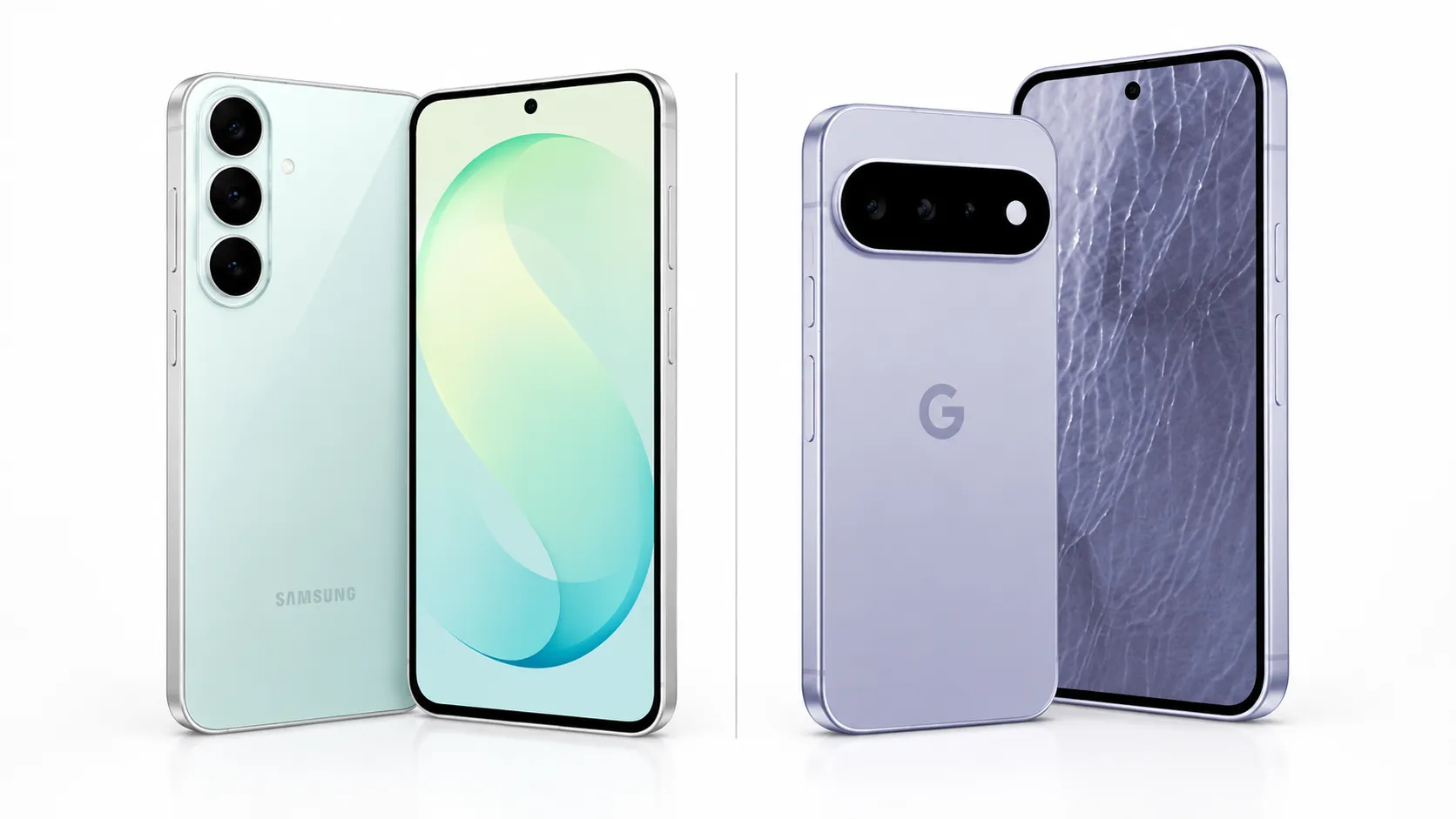
Samsung's Galaxy S26 FE and Google's Pixel 11 offer two different routes to a flagship Android experience, with roughly $100 separating their 256GB models in the United States. The Galaxy S26 FE costs $799.99 at its regular retail price, while the Pixel 11 starts at $899. Choosing between them comes down to more than the price difference.
Samsung offers a larger display, faster wired charging, and its feature-rich One UI software. Google counters with a smaller design, longer optical zoom, more RAM, and magnetic wireless charging. Both phones launched in 2026 and have undergone independent testing, revealing advantages and compromises that aren't always obvious from their specifications.
Galaxy S26 FE vs. Pixel 11 price: What $100 buys you
Samsung's US retail listing puts the Galaxy S26 FE at $699.99 for 128GB and $799.99 for 256GB. Google's August 12 announcement confirmed a $899 starting price for the Pixel 11, which comes with 256GB of storage.
That leaves a $99.01 difference between comparable configurations. Samsung also offers a less expensive 128GB option, although buyers choosing it get half the Pixel's base storage.
The higher-priced Pixel includes 12GB of RAM, compared with 8GB on the Samsung, alongside a longer optical zoom lens and faster wireless charging. Samsung provides a larger screen and its own set of software features for less.
Promotions can change the calculation. Samsung has advertised discounts on the S26 FE, while Google offers trade-in incentives. The $100 comparison reflects regular prices rather than temporary offers, so checking the final checkout price remains worthwhile.
Display and performance: Size, speed, and gaming
The Galaxy S26 FE has a 6.7-inch FHD+ Dynamic AMOLED 2X display, providing more room for videos, games, and multitasking than the Pixel 11's 6.3-inch OLED panel. Google's smaller dimensions make it the more natural choice for buyers who prefer a less bulky phone.
Despite its larger screen, Samsung's phone weighs 193 grams, slightly less than the Pixel's approximately 197 grams. Both displays support refresh rates up to 120Hz, though neither offers the more sophisticated LTPO technology found in some premium flagships.
Google has the brighter screen. According to its official specifications, the Pixel 11 reaches up to 3,000 nits of peak brightness, compared with Samsung's advertised 1,900 nits.
Independent measurements support that advantage. GSMArena recorded approximately 2,800 nits in a small test window on the Pixel, compared with just over 1,800 nits on the Galaxy S26 FE under similar conditions. The difference favors Google for outdoor visibility and bright HDR content.
Performance is a closer contest. Samsung uses the Exynos 2500, while Google relies on its Tensor G6. Both are manufactured using 3nm processes, but their performance characteristics differ.
In its September 24 Galaxy S26 FE review, TechRadar recorded Geekbench 6 scores of 2,361 in single-core and 7,831 in multi-core testing. The phone delivered capable everyday performance, although its 8GB of RAM leaves less headroom for demanding multitasking.
GSMArena's Pixel 11 testing found substantial CPU improvements over the previous Tensor generation, but comparatively modest GPU gains. Some games also struggled to exceed 60 frames per second.
Neither phone is an obvious gaming winner. Buyers who regularly play demanding titles should pay closer attention to sustained frame rates and thermal behavior than processor names or memory capacity alone.
Charging and battery: Samsung's wired advantage meets Pixel's magnetic charging
The Galaxy S26 FE supports 45W wired charging, with Samsung claiming a charge of approximately 69% in 30 minutes using a compatible adapter. Google advertises up to 55% in the same period with a suitable USB-C PPS charger.
Neither manufacturer includes the power adapter required for its advertised wired-charging performance.
Independent testing reinforces Samsung's wired-charging advantage. GSMArena found that the S26 FE could complete a full charge in roughly an hour, while the Pixel 11 took approximately 79 minutes using its faster Extreme Charging setting.
Google has the stronger wireless-charging specification. The Pixel supports magnetic Qi2.2 charging at up to 25W, compared with Samsung's 15W wireless charging. Built-in magnets also make compatible accessories easier to align and attach.
Samsung counters with Wireless PowerShare, which can recharge compatible earbuds and other accessories from the phone's battery.
The two batteries are nearly identical in capacity: 4,900 mAh for Samsung and 4,985 mAh for Google. However, similar capacities do not guarantee similar endurance.
GSMArena's Galaxy S26 FE battery tests found improved endurance over the previous model, despite the unchanged battery capacity. The Pixel also improved over its predecessor, though neither device leads the wider flagship market in battery life.
Cameras and AI: Google's longer zoom meets Samsung's video tools
Google's Pixel 11 has a 48MP main camera, 13MP ultrawide, and 10.8MP telephoto with 5x optical zoom. Samsung uses a 50MP main camera, 12MP ultrawide, and 8MP telephoto with 3x optical zoom.
The Pixel's longer optical reach gives it a practical advantage when photographing distant subjects. Its larger main sensor also represents an upgrade over the Pixel 10, although camera quality depends on processing and shooting conditions as much as hardware.
In its September 8 Galaxy S26 FE camera review, GSMArena found that Samsung's main camera produced detailed daylight images. Its smaller telephoto sensor was less convincing, particularly in low light, while the ultrawide and selfie cameras lacked autofocus.
The publication's Pixel 11 camera testing found the 5x telephoto useful, although images beyond native magnification could lose sharpness. The review also identified weaker 2x results and occasional inconsistencies in video stabilization while moving.
Samsung offers several tools aimed at video creators. My FanCam automatically tracks a selected person, while Super Steady with Horizontal Lock helps keep footage level during movement. Photo Assist can also edit images through natural-language instructions.
Google emphasizes computational photography with Magic Capture, Night Sight, and Tensor G6-powered image processing. Those features complement the Pixel's longer zoom, though software processing cannot eliminate every limitation of its camera hardware.
AI extends beyond photography. Samsung's Galaxy S26 FE announcement details One UI 9 features including Circle to Search, personalized Now Brief cards, and Photo Assist. Google integrates Gemini Intelligence and on-device Gemini Nano processing into the Pixel experience.
Some AI tools require supported languages, apps, accounts, or an internet connection. Samsung also offers eligible S26 FE buyers a six-month Google AI Pro trial with 5TB of storage, while Google's comparable introductory offer is reserved for eligible Pixel 11 Pro models, not the standard Pixel 11.
Samsung retains another useful feature for multitaskers: wireless DeX. It allows the phone to provide a desktop-style interface on a compatible external display, although the S26 FE lacks wired DeX and DisplayPort video output.
Both manufacturers promise seven years of software support. Samsung includes up to seven generations of OS upgrades and seven years of security updates, while Google provides seven years of OS, security, and Pixel Drop updates.
Galaxy S26 FE or Pixel 11: Which should you buy?
The Galaxy S26 FE makes the stronger value argument for buyers who prefer a larger display, faster wired charging, and Samsung's software features. Its $799.99 regular price for 256GB also leaves more room in the budget for accessories, although the 8GB RAM configuration and modest telephoto hardware are compromises.
The Pixel 11 is better suited to buyers who want a smaller phone, longer optical zoom, brighter display, more RAM, and magnetic wireless charging. Those advantages are tangible, but they won't necessarily justify another $100 for someone who rarely uses zoom photography or wireless charging accessories.
Independent testing also shows that both have weaknesses. Samsung's camera hardware trails more expensive flagships in some situations, while Google's graphics performance and certain camera results remain less impressive than its strongest features.
For a spacious screen, Samsung customization, and a lower purchase price, the Galaxy S26 FE is the better-value choice. The Pixel 11 earns its premium for buyers who will regularly use its stronger zoom, compact design, and magnetic charging ecosystem.
The deciding factor isn't which phone has more features on paper. It's whether the features that distinguish it are worth paying for every day.




Comments
Be the first, drop a comment!