





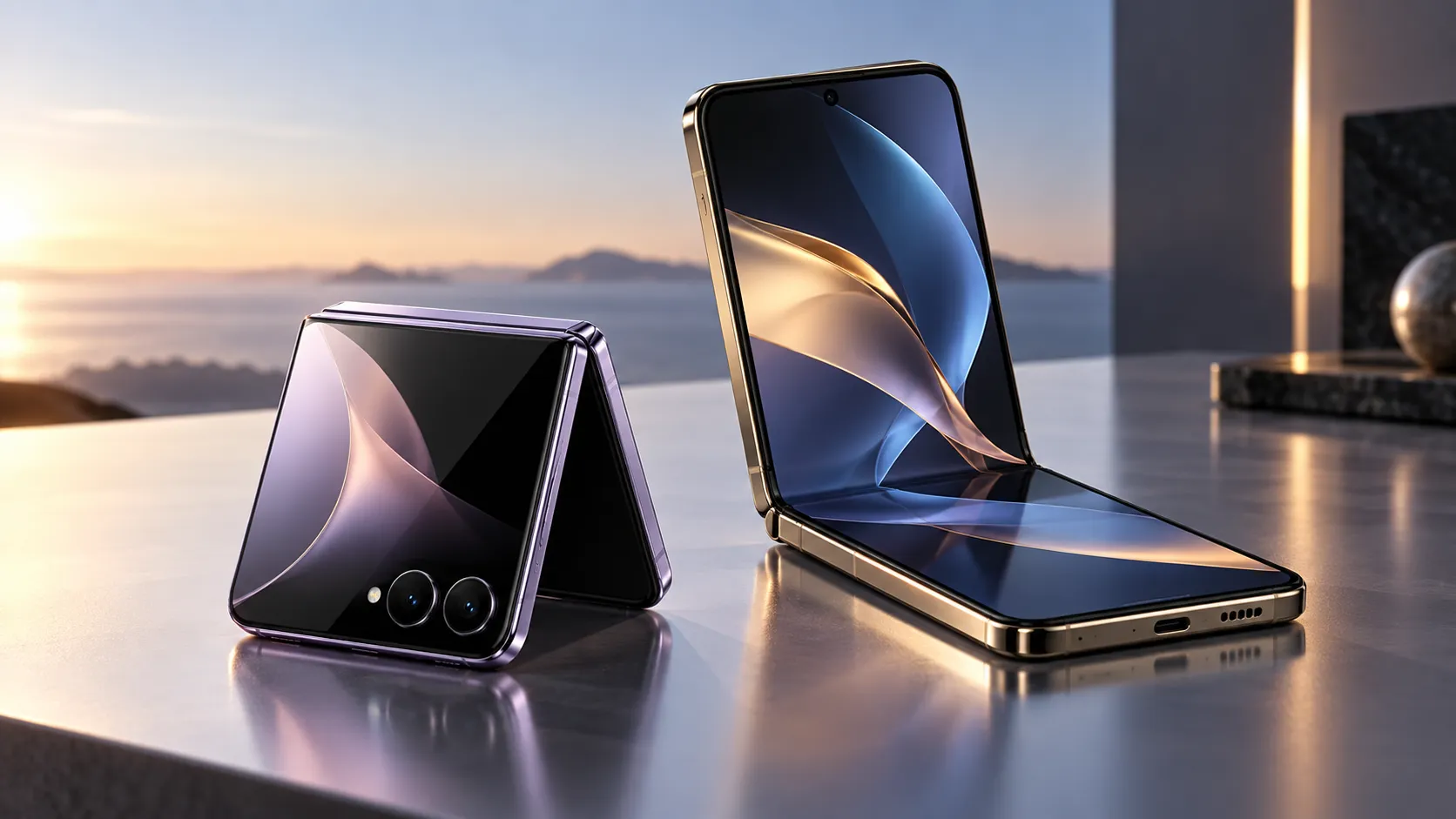
Flip phones spent years asking buyers to accept a smaller, weaker phone in exchange for a fun shape to unfold. That compromise mostly doesn't exist anymore. Are modern flip phones worth it in 2026? Based on two current US flagships, Samsung's Galaxy Z Flip8 and Motorola's Razr Ultra 2026, the answer is yes for a specific kind of buyer, and no for another.
The Galaxy Z Flip8 starts at $1,199.99 for 256GB, while the Razr Ultra 2026 launched at $1,499.99. Both phones carry an IP48 rating, which protects against solid objects larger than 1mm but doesn't provide full protection against fine dust or sand.
This isn't a review of one phone over the other. It's an argument that the flip format itself, the cover screen, folded footprint, and ability to use the rear camera for selfies, has matured into something worth real consideration next to a standard slab phone.
Where the Flip8 and Razr Ultra 2026 diverge on battery, charging, and camera hardware, that's a model decision, not proof the category solved its old weaknesses across the board.
Reasons to Buy a Modern Flip Phone Instead of a Regular Smartphone
The clearest gain in this format is that closed-phone use has gone from a gimmick to something much closer to a substitute for repeatedly unlocking the full phone.
Both current flagships build around that idea. The Flip8 uses a 4.1-inch FlexWindow running at up to 120Hz, with Samsung expanding the apps and controls available without unfolding the device.
The Razr Ultra 2026 has a 4-inch external display that runs at up to 165Hz. Motorola says it can run full apps, handle replies, and keep maps, music, notifications, and other functions accessible while the phone stays folded.
Motorola also includes Daily Drop, a feed of calendar events, weather, news, and photo memories, similar in purpose to Samsung's Now Brief.
None of this eliminates the main screen. Streaming longer videos, gaming, reading, and other full-screen tasks are generally better after unfolding the phone.
The benefit is narrower but real: anyone who checks a phone often but briefly gets a genuine shortcut. Anyone whose habits are mostly long, full-screen sessions won't gain nearly as much.
A Smaller Footprint, With an Honest Thickness Trade-Off
Folded, the Flip8 measures 85.7 x 75.4 x 13.1mm and weighs 180 grams, making it thinner and 8 grams lighter than the Flip7 it replaced.
The Razr Ultra 2026 folds to roughly 88.1 x 74 x 15.7mm and weighs 199 grams, making it around 2.6mm thicker and 19 grams heavier than the Flip8 when closed.
Unfolded, the Flip8 opens to a 6.9-inch display and the Razr Ultra 2026 to a 7-inch display, so both are carrying a full-size flagship screen inside a folded shape that's dramatically shorter in a pocket or bag.
That's the actual trade: less height when folded, plus a screen that closes face-in, in exchange for more thickness than a conventional slab phone.
Buyers chasing the thinnest possible phone in hand should know a flip is thinner when open and thicker when folded, not simply "smaller" across every dimension.
The Rear Camera Doubles as a Sharper Selfie Camera
Because the cover display can act as a viewfinder, both phones let people shoot selfies with their main rear cameras instead of relying only on the dedicated front sensor.
Samsung's Flip8 has a 50MP main camera and 12MP ultrawide, both usable with the FlexWindow for rear-camera selfies.
The Razr Ultra 2026 pairs a 50MP main camera with a 50MP ultrawide. Its cover screen provides the same basic advantage: frame the shot from the outside and use the stronger rear-camera hardware without opening the phone.
Megapixel counts alone don't prove better selfies than a dedicated front camera would produce. Sensor size, processing, framing, and lighting matter more than the number on a spec sheet.
This feature matters most to people who take frequent selfies, group photos, or social content and want the flexibility of the main cameras. It's largely irrelevant to anyone who rarely uses a front-facing camera.
Where the Flip8 and Razr Ultra 2026 Actually Differ
Battery size, charging speed, and camera hardware differences between these two phones aren't evidence that flip phones as a category fixed their old weaknesses. They're evidence that one model currently carries stronger specifications in particular areas.
The Razr Ultra 2026 packs a 5,000mAh silicon-carbon battery with 68W wired and up to 30W wireless charging. Motorola says the battery can provide up to 36 hours of use under its testing conditions.
The Flip8 uses a smaller 4,300mAh battery with 25W wired and up to 15W wireless charging. Samsung rates it for up to 31 hours of video playback.
Those manufacturer estimates aren't directly comparable because the companies use different testing methods. The safe conclusion is that Motorola has the larger battery and faster charging hardware on paper, not that it automatically delivers better real-world battery life in every workload.
Software support is another divide.
Samsung promises the Flip8 up to seven generations of OS upgrades and seven years of security updates.
Motorola's current support page lists the Razr Ultra 2026 for regular security updates through February 2030 and identifies Android 17 as its next OS version. Motorola doesn't publish an equivalent seven-generation commitment for the device.
That gives Samsung the clearer long-term support advantage at these prices.
Two Trade-Offs That Aren't the Same Problem
Dust exposure and screen-protector damage often get lumped together as one vague "durability concern," but they're separate risks with separate causes.
Both phones carry an IP48 rating. The first digit means protection against solid foreign objects larger than 1mm, not complete sealing against fine dust.
That means sand, fine workshop debris, and other smaller particles remain a different proposition from ordinary pocket lint. Calling either phone fully dustproof would overstate what IP48 guarantees.
The flexible inner display creates another consideration. Modern foldables use a factory-installed protective layer as part of the display assembly, and peeling or damaging that layer yourself can create an avoidable repair problem.
That's separate from the IP rating. One concerns particles entering the device; the other concerns the flexible screen itself.
Both risks sit on top of flagship-or-higher pricing, from $1,199.99 for the Flip8 to $1,499.99 at the Razr Ultra 2026's launch. A hinge and flexible multi-layer screen also introduce moving and flexible components that a conventional slab flagship doesn't have.
Treat these as separate checklist items: don't assume IP48 protects against fine sand or dust, and don't peel the factory-installed inner-screen protector yourself.
Flip8, Razr Ultra 2026, or Neither
Choose the Flip8 if the lower entry price, thinner and lighter folded design, and long software-support commitment matter most. It starts about $300 below the Razr Ultra 2026's launch price and comes with Samsung's seven-generation OS and seven-year security promise.
Choose the Razr Ultra 2026 if the larger 5,000mAh battery, 68W wired charging, 30W wireless charging, 50MP ultrawide camera, and 165Hz external display are worth paying more for. Its hardware specifications are stronger in several areas, but Samsung offers the longer documented support runway.
Choose neither and buy a conventional slab flagship if fine-dust exposure is common, repair uncertainty is unacceptable, or the benefits of folding don't outweigh paying $1,200 or more for a phone with a flexible display and hinge.
Check protection-plan terms before relying on insurance as a backstop. Samsung Care+ and Motorola protection options can change in price, deductible, and covered failure type, so verify current terms for the exact phone before assuming hinge, display, or debris-related damage is covered.
Are Modern Flip Phones Worth It?
The format itself has earned a real look.
A useful cover screen can replace dozens of routine unlocks. The folded shape is genuinely easier to carry despite being thicker. And using the rear cameras for selfies gives the design a photographic advantage a conventional slab can't copy in quite the same way.
The Flip8 makes the strongest case for buyers who want the format with the lower entry price, lighter body, and longest documented software runway.
The Razr Ultra 2026 asks more money but gives that premium back in hardware: a bigger battery, substantially faster charging, a higher-refresh external display, and more aggressive camera specifications.
Neither eliminates the fundamental foldable compromises. Fine dust remains outside what IP48 fully protects against, the flexible screen still needs more care than conventional glass, and repairs can be more complicated than on a slab phone.
For buyers who will actually use the cover screen and value the compact folded shape, modern flip phones are no longer novelty purchases. For anyone who would spend most of the day with the phone unfolded anyway, a conventional flagship remains the simpler buy.


Comments
Be the first, drop a comment!