



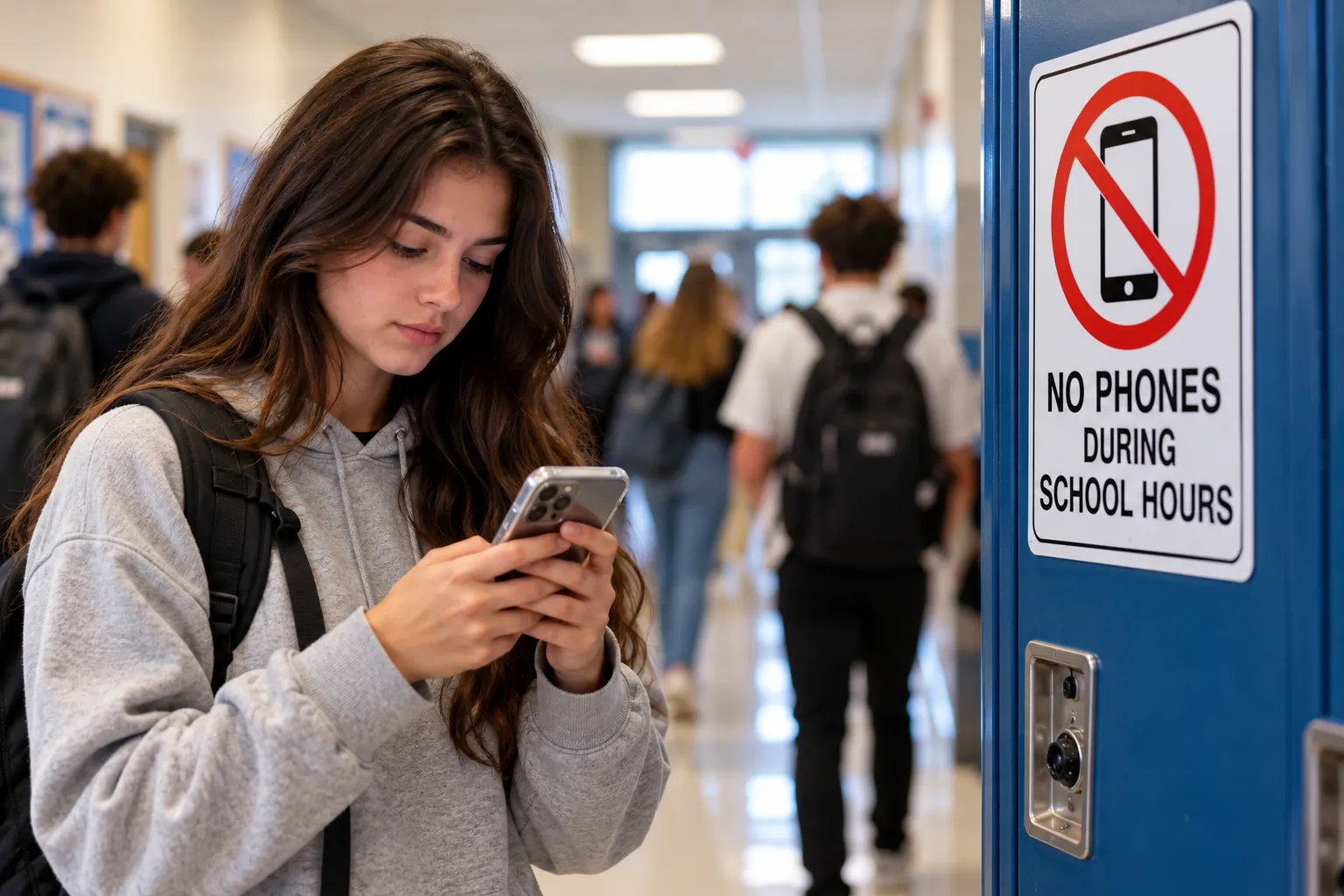
The idea that high school students oppose full-day cellphone bans gets repeated as settled fact, but the national data behind it cover a broader group than high schoolers alone.
A Pew Research Center survey conducted in fall 2025 found that 41% of US teens ages 13 to 17 support banning phone use during class, while 17% support a ban that runs through lunch and passing periods too. Seventy-three percent oppose that broader rule.
This isn't a hypothetical policy debate for most students. Public schools already restrict phones during instructional time in large numbers: 77% prohibit students from having phones during class, according to the National Center for Education Statistics.
A separate teen panel surveyed by Brookings found that 56% reported attending schools with a bell-to-bell ban covering the entire day, while 44% attended schools with narrower rules, typically covering instructional time only.
Pew's sample spans ages 13 to 17, which includes middle schoolers, and Brookings also surveys teens broadly. Neither dataset exclusively represents high school students, although Pew provides age-group breakdowns. The clearest pattern is that opposition increases as a rule's scope expands, rather than reflecting a blanket rejection of all phone restrictions. What the data don't fully establish is why, and that gap matters for how this debate gets framed.
The opinion divide: classroom rules vs. all-day bans
Support drops sharply as a policy's reach expands. Pew Research Center found that 41% of teens support a classroom-only ban, with 51% opposed and 9% unsure. Support falls to 17% for a ban covering the full school day, which 73% oppose.
Pew's age breakdown also provides some insight into older teens' views. Among those ages 15 to 17, 39% support classroom bans and 15% support all-day restrictions. Among teens ages 13 to 14, support stands at 43% and 21%, respectively. These age groups don't map perfectly onto middle and high school enrollment, but they show that support for all-day bans is particularly low among older teens.
A related pattern appears in Brookings' questions about eliminating classroom screens entirely. Support was much higher for elementary school classrooms (57%) than for high school classrooms (16%). Adults responding to the same questions showed 62% support for elementary classrooms and 41% for high school classrooms.
Those findings concern all classroom screens, not cellphones alone, so they shouldn't be treated as another measure of support for cellphone bans. Still, they show that teens and adults distinguish between restrictions at different grade levels.
Adults also back cellphone restrictions more strongly than teens in Pew's survey comparisons. Seventy-four percent of adults support classroom cellphone bans, compared with 41% of teens. For all-day bans, support stands at 44% among adults and 17% among teens.
The direction is consistent: support is substantially lower for full-day restrictions than for classroom-only rules, and teens are less supportive than adults.
What the data don't establish: the safety question
Public debate over cellphone bans often assumes teens oppose full-day rules because of safety concerns, emergency access, or a desire to reach family during the school day. The published Pew findings measure support and opposition, not the reasons behind those views, so that explanation remains plausible but unconfirmed by the survey.
Brookings provides additional context through teens' reported experiences with school phone rules, including open-ended responses, but its published findings don't establish how much opposition to full-day bans is specifically driven by emergency-access concerns.
The institutional case for stricter rules, meanwhile, often centers on learning and student well-being. School leaders report concerns tied to cellphone use: 72% say it negatively affects students' mental health, 73% cite attention spans, and 53% cite academic performance, according to NCES.
Those numbers reflect administrators' perceptions, not independently measured effects, and they don't explain why teens themselves oppose full-day bans.
The safety rationale therefore remains an open question in the evidence reviewed here rather than an established explanation for the opposition Pew measured.
Does stricter enforcement actually reduce phone use?
Brookings surveyed a nationally representative panel of teens from the Understanding America Study in October 2025 and again in May 2026, covering students in public, private, and charter schools. Reported in-class phone use rose over that period, from 28% in October to 42% in May.
The increase was smaller in schools with bell-to-bell policies. Teens in those schools went from 25% to 35% reporting phone use during core classes, a 10-percentage-point rise. Teens under less-strict policies saw an 18-point increase, from 32% to more than 50%.
That difference suggests stricter policies may be associated with smaller increases in classroom phone use over time. But the figures cover self-reported behavior in core classes. They don't establish how often students use phones during lunch or passing periods, how policies work during emergencies, or whether the restrictions themselves caused the difference.
Enforcement data also reveal a gap between teen and adult perceptions. Forty-four percent of teens said their teachers became less strict about enforcing classroom phone rules over the school year. By contrast, only 13% of surveyed adults living with teens reported that enforcement had become less strict, while 60% perceived no change.
Those figures come from different respondent groups, not two questions answered by the same teens. The discrepancy shows that adults and students may perceive enforcement differently, although the survey doesn't establish why.
Well-being measures moved in a different direction from the reported phone-use numbers. The share of teens saying school phone rules made them unhappy fell from 48% in October to 27% in May. Across the well-being and school-experience measures Brookings examined, the average share reporting no impact rose from 56% to 63%, while the average reporting a negative impact dropped from 24% to 17%.
These are self-reported perceptions spanning happiness, stress, academic experiences, and teacher relationships, not independently measured outcomes. Still, the trend runs counter to the idea that students necessarily become more dissatisfied with phone restrictions over time.
Brookings also examined whether school restrictions affected phone use outside school. Fifty-eight percent of teens said their school's policy had no effect on how much they used their phones outside school. Twelve percent said the policy led them to use their phones less than they otherwise would, while 30% reported using them more.
That 30% figure is worth watching, but it's a perception reported by teens, not evidence that bans cause a rebound in phone use once students leave campus.
What a bell-to-bell cellphone ban in high schools actually covers
"Cellphone ban" gets used as a catch-all term, but NCES data distinguish several measures that shouldn't be added together.
Seventy-seven percent of public schools reported policies prohibiting students from having phones during any class. Separately, 38% of schools with cellphone policies restricted use outside class, including free periods, time between classes, extracurricular activities, and meal periods. A third measure found that 30% of all public schools prohibited phones during classes and restricted their use elsewhere at school.
Each number answers a different question, and the figures come from NCES data collected in December 2024. The same survey found that 55% of high and secondary schools prohibited students from having phones during class, compared with 86% of elementary schools.
Earlier data show how much policies differed by school level. In the 2021-22 school year, 43% of high and secondary schools prohibited nonacademic cellphone use, compared with 87% of elementary schools and 77% of middle schools, according to NCES school safety data.
Those older figures may not reflect subsequent policy changes, including the expansion of bell-to-bell restrictions.
The distinctions between possession and use, classroom-only and all-day rules, and academic and nonacademic settings help explain why one school's "ban" can look different from another's. A policy might prohibit active phone use throughout the day while allowing students to keep devices in their bags. Another might require phones to be stored in lockers or locked pouches.
Brookings defines bell-to-bell restrictions as prohibiting cellphone use throughout the school day, including noninstructional periods. How schools enforce those rules can vary, and the national surveys don't measure every storage method, exception, or enforcement practice uniformly.
Given how much these categories differ, checking a school's written policy matters more than relying on the "cellphone ban" label alone. Parents and students should confirm whether the rule prohibits possession or use, how phones are stored, what exceptions exist for medical or accessibility needs, and whether restrictions extend to lunch and passing periods.
Schools should also be able to explain how families can contact students during emergencies. If that information isn't clear, request the district's written emergency-communication policy rather than relying on informal assurances.







Comments
Be the first, drop a comment!