





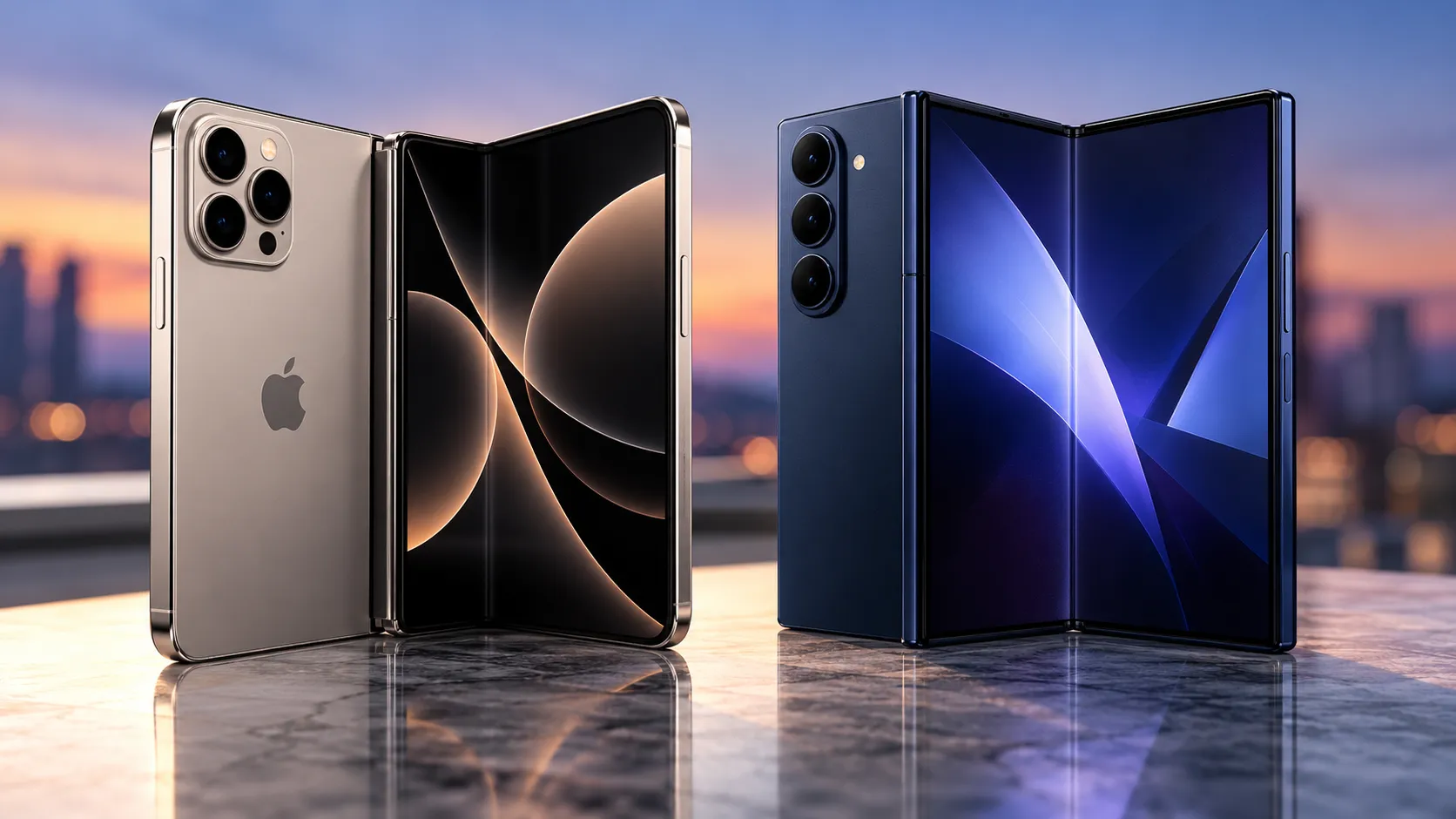
Apple's first foldable iPhone goes on sale this Friday, Oct. 23, after preorders opened Oct. 16. The iPhone Duo starts at $1,999, and Apple says the device has an IP68 dust-and-water rating and a stiffer polymer cover layer to protect the folding display.
Those are company-published specifications and claims, not independent durability results, and that puts the Duo exactly where every foldable before it started: with questions only outside testing and long-term use can answer.
That's the recurring issue in foldable phone evolution going back almost a decade. iFixit called Samsung's Galaxy Z Fold8 the nicest foldable the company has made, the kind of device that finally feels built for mainstream buyers instead of early adopters. The same teardown produced grinding hinge noises after iFixit deliberately exposed the phone to fine dust and repeatedly worked the hinge, and the Fold8 earned a provisional repairability score of 4 out of 10.
That isn't evidence that ordinary Fold8 units spontaneously develop hinge problems. It does show why Apple's first attempt deserves scrutiny before anyone hands over $1,999.
Royole launched the FlexPai in October 2018 as the first commercially available foldable smartphone with a flexible display, with order fulfillment beginning that December. This explainer traces what actually changed in foldable engineering between that phone and today's devices, separates company claims from independently observed results, and gives current Samsung foldable owners, Android shoppers, and prospective Duo buyers a concrete way to judge the durability question themselves.
What early foldables gave up to make folding possible
Royole introduced the FlexPai on Oct. 31, 2018, with a single 7.8-inch AMOLED display that folded outward, leaving the flexible screen exposed when the phone was closed.
Prices started at about $1,300, establishing the foldable category as a premium proposition from its first commercial device.
Flexible displays presented a basic materials problem. Conventional rigid smartphone cover glass couldn't simply fold in half, so early manufacturers relied heavily on flexible polymer materials.
Samsung's original Galaxy Fold showed how difficult that transition could be. Unveiled in February 2019, its planned April launch was delayed after problems emerged with early review units. Some reviewers removed a polymer layer they mistook for an ordinary screen protector, damaging the display, while other units experienced separate display failures.
Samsung revised the design before releasing the phone later in 2019.
Modern foldables have moved well beyond those earliest designs, incorporating ultra-thin glass, protective polymer layers, redesigned hinges, stronger support structures, and improved ingress protection. But flexible inner displays still require different compromises from the rigid glass screens on conventional phones.
How clamshells and tri-folds spread the format across different needs
Once manufacturers had workable folding displays, they began shaping the format around different priorities.
Motorola revived the folding clamshell concept with its 2019 Razr, emphasizing pocketability. Samsung followed with the Galaxy Z Flip. Book-style devices such as Samsung's Galaxy Fold prioritized a larger tablet-like screen when opened.
Some early designs, including Huawei's original Mate X, folded outward, leaving the flexible display on the exterior of the closed device.
Manufacturers later added devices with two hinges and three display sections, increasing usable screen area while adding another folding interface to engineer around.
The basic mechanical constraint hasn't changed: batteries, circuit boards, cameras, and many other components remain rigid. Foldable phones therefore bend at deliberately engineered locations while the rest of the device stays comparatively inflexible.
How manufacturers reinforce those folding points has become one of the biggest areas of development.
What Samsung's Galaxy Z Fold8 reveals about the evolution of foldable smartphones
The findings below come primarily from one iFixit test unit and teardown. They document what happened to that device under iFixit's testing, not a failure rate across Fold8 units in normal use.
The Fold8 pairs a redesigned hinge with Samsung's Flex Titanium display structure. It combines a thin titanium-alloy film with a perforated titanium support plate beneath the folding display.
Samsung says the titanium-alloy film provides 20 times the mechanical stiffness of the polymer film used previously. The company also says the structure improves support and helps reduce crease visibility.
Those are Samsung's engineering claims. Long-term ownership data will be needed to establish how the design ages in everyday use.
iFixit also tested the Fold8's resistance to fine particles. Its test was deliberately more aggressive than the phone's IP certification: iFixit introduced UV-reactive powder containing particles much smaller than the 1mm threshold covered by an IP4X rating and then worked the hinge open and closed.
After that exposure, the hinge developed crunching and grinding noises and stopped opening normally.
That context matters. The test demonstrates a vulnerability to fine-particle ingress under iFixit's conditions, not evidence that normal repeated folding by itself caused the hinge failure.
The Fold8 carries an IP48 rating. Under the IP system, the first digit, 4, denotes protection against solid foreign objects 1mm in diameter and larger. It doesn't certify the phone as dust-tight. The second digit, 8, denotes water-ingress protection under manufacturer-specified test conditions.
Samsung itself advises users to keep foldable devices away from dust and other particles that could damage them.
Repairability presents a separate concern.
During iFixit's teardown, the plastic bezel around the folding display chipped and broke during removal, and the inner screen didn't survive the procedure. iFixit also found that accessing the hinge and inner-display assembly creates substantial repair complexity.
Those findings contributed to a provisional repairability score of 4 out of 10.
Taken together, the teardown provides useful evidence about Samsung's latest Fold generation, but it needs to be read within the limits of the test. The hinge problem followed deliberate exposure to particles below the Fold8's certified solid-ingress threshold, while the repairability problems emerged during disassembly.
Neither should be converted into a claim that ordinary Fold8 units are broadly failing.
What Apple claims for iPhone Duo and what still needs testing
Apple rates the iPhone Duo IP68 under IEC 60529, including water resistance to a maximum depth of 6 meters for up to 30 minutes under controlled laboratory conditions.
That's a stronger solid-ingress certification than the Fold8's IP48 rating: the first digit of 6 indicates a dust-tight enclosure under the standard's test conditions, whereas the Fold8's 4 rating covers objects 1mm and larger.
That distinction is real, but it doesn't prove how either phone will survive every real-world encounter with beach sand, grit, wear, drops, or a contaminated hinge. IP testing covers specific standardized conditions rather than every form of long-term use.
Apple also describes the Duo's hinge as being engineered from more than 100 components. Its folding inner display uses a custom polymer cover layer that Apple says provides up to 40% greater stiffness than other materials used in the industry, along with high-strength glass layers, custom adhesives, and a titanium support plate.
Ceramic Shield 2 on the outer display offers 3x better scratch resistance than the previous generation, according to Apple.
All of those are manufacturer claims awaiting independent verification on retail Duo hardware.
The Duo has a 5.4-inch outer display and 7.6-inch inner display, and both use the same aspect ratio so content can scale proportionally between them. iOS 27 also introduces Split View multitasking for the Duo's larger inner display.
At $1,999, the Duo enters the same ultra-premium territory as today's large foldables. Until independent testers and teardown specialists examine retail units after launch, the gap between Apple's engineering claims and independently measured durability remains open.
What to check before buying any modern foldable phone
Foldables have become considerably more refined since the FlexPai era, but specifications still don't answer every durability question.
Before buying a current or upcoming foldable, check:
The exact IP rating and what each digit certifies, rather than relying on broad phrases such as "water resistant" or "dust resistant."
The manufacturer's warranty and accidental-damage coverage for the folding display.
Current repair pricing for the inner display and hinge assembly.
Whether official replacement parts and service documentation are available.
Independent testing involving fine particles, hinges, drops, and repeated use, while paying attention to whether the test exceeds the conditions covered by the phone's certification.
Crease visibility and hinge behavior after months of ownership rather than relying solely on launch-day impressions.
What to do before you buy, upgrade, or wait
Galaxy Z Fold8 owners shouldn't interpret iFixit's hinge result as evidence that their phone will develop the same problem through normal folding. The failure occurred after deliberate exposure to fine particles smaller than those covered by the Fold8's IP4X solid-ingress certification.
It does reinforce the reason to follow Samsung's handling guidance and keep potentially damaging particles away from a foldable's hinge and inner display.
Owners of older Galaxy Fold or Z Flip models should check their particular model's ingress rating and care instructions rather than assuming the Fold8's protections apply to earlier generations.
Android shoppers considering the Fold8 are looking at hardware iFixit described as thinner, lighter, and substantially more mature than early folding phones. That polish doesn't erase the difficult inner-display and hinge repair path that produced its provisional 4/10 repairability score.
Prospective iPhone Duo buyers face a different uncertainty. Apple's IP68 certification is established, but claims about hinge feel, display durability, crease behavior, and long-term reliability still need independent testing of retail hardware.
Preordering means accepting that those long-term answers don't exist yet.
Either way, the decision comes down to the same check. If you need a foldable now, compare current repair coverage, pricing, ingress protection, and independent testing before buying.
If the Duo is the one under consideration and long-term durability matters more than being first, wait for retail-unit teardowns and sustained real-world testing. Eight years of commercial foldables have produced dramatically thinner, lighter, and more polished hardware, but the fold itself remains the part worth investigating most closely.






Comments
Be the first, drop a comment!