





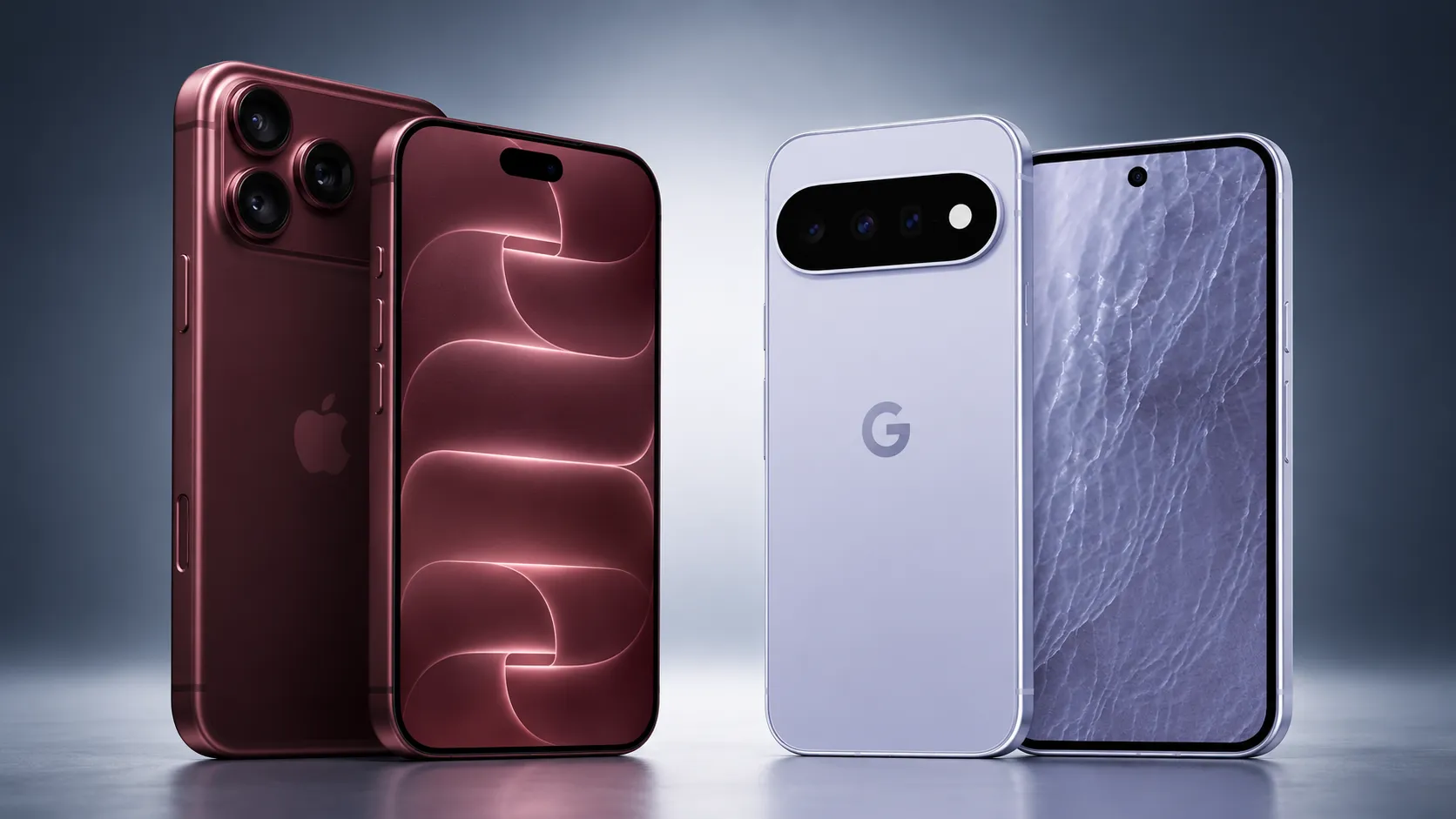
Apple and Google have landed surprisingly close together with their latest Pro phones. The iPhone 18 Pro and Pixel 11 Pro both have 6.3-inch 120Hz OLED displays, triple-camera systems, 256GB of base storage, and an increasingly heavy emphasis on AI.
But they do not make the same case for your money. Google's Pixel 11 Pro leans into computational photography, long-range zoom, and Gemini-powered features you can already use. Apple's iPhone 18 Pro puts more weight behind raw performance, manual camera controls, professional video, and its new Siri AI experience.
Timing matters, too. The Pixel 11 Pro has been on sale since August 20 and has already gone through full independent reviews. iPhone 18 Pro preorders opened September 12, but Apple says retail availability begins September 18. Apple's official iPhone 18 Pro announcement confirms its hardware, pricing, and feature claims, but real-world battery life, sustained performance, and camera quality still need broader testing.
That makes this less a simple scorecard than a question of priorities: Do you want Google's more mature AI tools and stronger zoom today, or Apple's more ambitious performance, video, and camera-control package?
iPhone 18 Pro vs. Pixel 11 Pro: The biggest differences
These phones overlap in plenty of ways. Both use 6.3-inch OLED displays with adaptive refresh rates up to 120Hz, both start with 256GB of storage, and both carry three rear cameras.
The differences are more useful than the similarities.
The Pixel 11 Pro starts at $1,099, while the iPhone 18 Pro starts at $1,199. Google offers up to 1TB of storage; Apple stretches to 2TB.
Google's 6.3-inch Super Actua display is rated for up to 3,600 nits of peak brightness, while Apple advertises up to 3,000 nits outdoors. Those figures are not measured under identical conditions, so they should not be read as proof that the Pixel will always look brighter in normal use.
Inside, Apple uses its A20 Pro chip, while the Pixel 11 Pro runs Google's Tensor G6. Google's full Pixel 11 Pro specifications also list a 4,850mAh typical battery, a 42MP autofocus selfie camera, and Qi2 wireless charging up to 25W.
The camera systems show the clearest split. Pixel 11 Pro combines a 50MP main camera, 48MP ultrawide, and 48MP 5x telephoto with up to 120x Pro Zoom. The iPhone uses three 48MP rear cameras, including a 4x telephoto, an 8x "optical-quality" option, and digital zoom up to 40x.
Pixel 11 Pro has the more established AI toolkit
If AI features are a major reason you're upgrading, Google currently has the easier case to make.
Pixel 11 includes tools such as Rambler, which can clean up rambling speech as it turns it into text, and Magic Capture, which analyzes a brief recorded moment to pull out well-timed still photos. Google's Gemini Intelligence also sits alongside familiar Pixel features such as Circle to Search and AI-assisted photo editing.
More importantly, reviewers have already had time to judge whether those ideas are useful.
In its Pixel 11 Pro review, The Verge found Rambler fast and effective and praised Magic Capture, while finding Google's Proactive Assistance inconsistent and HiLight underused. That makes Pixel's AI story feel more concrete than a simple list of promised features.
Apple's answer is Siri AI, which began rolling out in beta with iOS 27. Apple says the revamped assistant can draw on information in messages, emails, photos, and onscreen content to answer questions and take actions.
But availability varies by language and region, and Apple's newest Siri experience has not yet accumulated the same body of real-world testing.
For someone buying specifically for AI today, the Pixel 11 Pro has the advantage.
Pixel wins on zoom; iPhone adds more camera control
The Pixel 11 Pro's biggest photography advantage is reach. Its 5x telephoto can push all the way to 120x Pro Zoom with computational assistance.
That sounds excessive, but it is not purely a marketing stunt. Tom's Guide found the Pixel 11 Pro's 5x telephoto capable of sharp long-range shots and its AI-assisted 120x mode surprisingly effective.
Apple takes a different approach.
The iPhone 18 Pro uses three 48MP rear cameras. Its 4x telephoto can also produce what Apple calls an 8x "optical-quality" image, while digital zoom stops at 40x.
The more interesting upgrade is the main camera's variable aperture. Instead of staying fixed, it can switch among f/1.48, f/1.8, f/2.8, and f/4.0. Apple also exposes aperture, shutter speed, white balance, and other controls for users who want to shape a shot manually.
That gives photographers more control over light and depth of field rather than relying entirely on automatic processing.
So the split is fairly clean: Pixel 11 Pro has the stronger zoom system and already-tested point-and-shoot results, while iPhone 18 Pro gives photographers more direct control.
What remains unsettled is overall image quality. That needs proper side-by-side testing once the iPhone reaches reviewers and buyers.
iPhone 18 Pro has the stronger pro-video pitch
Apple separates itself more clearly when you move from photos to video.
The iPhone 18 Pro can record 4K Dolby Vision at up to 120 fps through its main camera and supports ProRes RAW, Apple Log 2, external recording, and genlock.
Most users will never need those features. If your videos mostly end up in Messages, Instagram, or TikTok, the Pixel is already more than capable.
But creators working with color grading, external storage, or multi-camera setups have much more to work with on the iPhone. For that audience, the iPhone 18 Pro is the stronger choice for video.
A20 Pro should be faster, but wait for comparable benchmarks
Apple's A20 Pro also looks likely to take the performance lead.
Apple says the chip's new 7-core GPU is up to 40% faster than A19 Pro. A redesigned vapor chamber, meanwhile, is claimed to improve sustained performance by as much as 40% over the previous generation.
Those are manufacturer results, not a completed iPhone-versus-Pixel benchmark.
The Pixel 11 Pro's Tensor G6 is more closely tied to Google's AI and computational-photography strategy. Independent testing suggests it improves on the previous generation, but raw performance is still not the Pixel's strongest selling point.
In its full testing, Tom's Guide found the Pixel 11 Pro improved over its predecessor but still behind rival flagships in raw performance.
For gaming and other demanding workloads, the iPhone is the safer bet. For everyday messaging, browsing, photography, and app use, both phones should feel fast.
Battery life is still the category to wait on
Battery claims are harder to compare because Apple and Google do not describe endurance in the same way.
Google advertises more than 30 hours of use for the Pixel 11 Pro. Apple's iPhone figures vary by activity and hardware configuration, including separate estimates for typical use and video playback.
Those are not equivalent tests.
The Pixel at least has independent battery testing available. The iPhone does not yet have enough retail-era testing to make the same comparison responsibly.
Charging is clearer. Apple says the iPhone 18 Pro can reach 50% in around 15 minutes with a compatible wired adapter. Google says the standard Pixel 11 Pro can reach up to 55% in about 30 minutes with a compatible charger.
If battery endurance is your deciding factor, wait for side-by-side testing.
Pixel 11 Pro is the better value today
At list price, Google has the immediate edge.
The 256GB Pixel 11 Pro starts at $1,099 compared with $1,199 for the 256GB iPhone 18 Pro. That is a $100 gap before trade-ins and carrier promotions.
And the difference can already be larger in practice. Ahead of Apple's September 18 retail launch, The Verge reported Pixel 11 Pro discounts that pushed its street price below MSRP.
Apple does give heavy media users one advantage: the iPhone 18 Pro can be configured with up to 2TB of storage, twice the Pixel's maximum.
For most people, though, Pixel 11 Pro offers the better value at today's prices.
So, which phone should you buy?
Buy the Pixel 11 Pro if you want mature AI features, stronger long-range zoom, and a lower price. Its newest software has already been tested in real-world use, and its camera system offers considerably more reach.
Choose the iPhone 18 Pro if manual camera control, high-end video, or raw performance matters more. Its variable-aperture camera is one of Apple's most interesting photography additions in years, while ProRes RAW, Apple Log 2, and genlock give serious video shooters tools the Pixel does not try to match.
If battery life or overall camera quality is your deciding factor, waiting still makes sense. The Pixel has weeks of independent testing behind it. The iPhone 18 Pro does not reach stores until September 18.
For now, the verdict is straightforward: Pixel 11 Pro is the stronger buy for AI, zoom, and value, while iPhone 18 Pro is the more compelling option for performance, camera control, and serious video work.
Neither phone gives satisfied users of the other platform an overwhelming reason to switch. But for anyone already shopping for a new flagship, the differences are meaningful enough to make the choice less about brand loyalty and more about what you actually want your phone to do.




Comments
Be the first, drop a comment!